
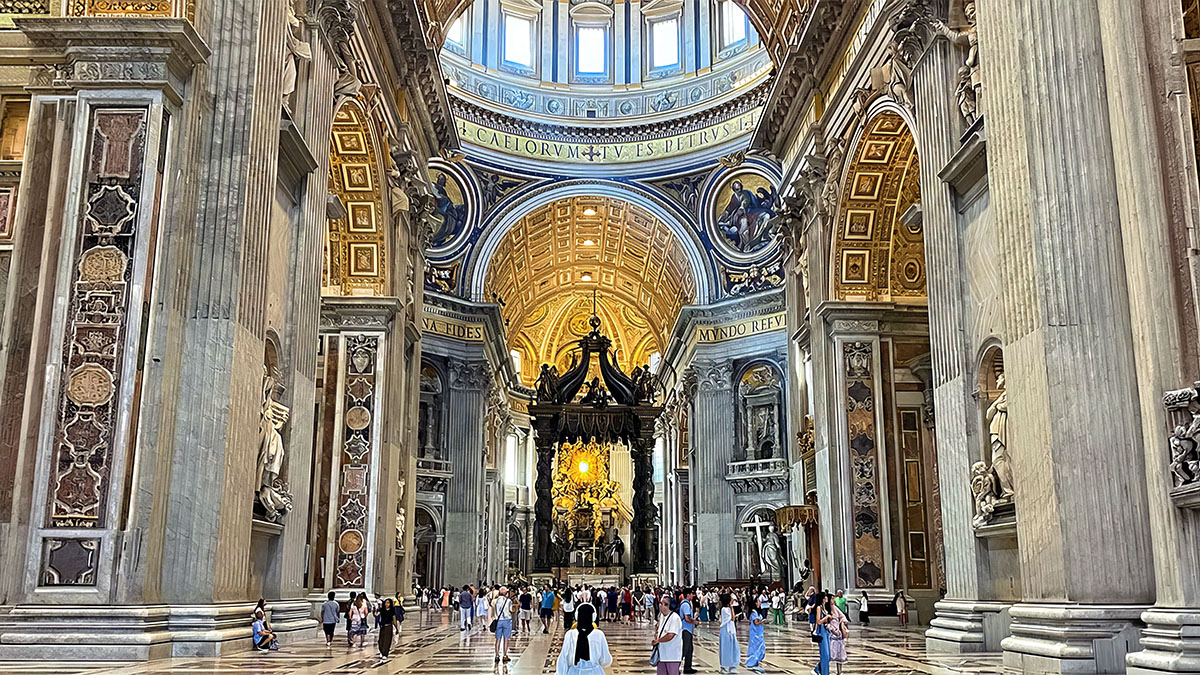
Perhaps papal adoration has always been part of Catholic life.
Looking across the mountains to Rome for affirmation, correction or decision is certainly nothing new. Yet something has changed.
The pope has become extraordinarily present in the everyday imagination of Catholicism.
We know what he said this morning, whom he met yesterday, where he will travel tomorrow, what he wore, where he lives, where he holidays and, before long, what somebody thinks all of this means.
I have lived through only six pontificates, including the present one, so my personal historical lens is necessarily short. Nevertheless, within that period the transformation is striking.
John Paul I, the man from Venice, was with us for only thirty-three days.
John Paul II became something altogether different: the travelling pope, the media pope and, eventually, a global religious celebrity.
Benedict XVI acquired an extraordinarily devoted following of his own.
Francis became simultaneously the pope of “Who am I to judge?” and, for some Catholics, the pope who could do almost nothing right.
Now we have Leo XIV and, scarcely more than a year into his pontificate, another industry of papal interpretation is firmly established.
This raises an uncomfortable question: do Catholics now need too much pope?
Papal adoration explained
By papal adoration I do not mean the legitimate Catholic recognition of Petrine primacy, communion with the Bishop of Rome or respect for his teaching office.
By using “papal adoration,” I mean something more cultural and affective: the habit whereby the personality, gestures, preferences, and almost daily utterances of the reigning pope become disproportionately determinative of Catholic identity.
This is not simply about liking the pope.
Papal adoration has a darker twin: papal detestation.
The Catholic who believes that everything the pope does is wonderful and the Catholic who spends every morning searching for evidence that the pope is destroying the Church may, paradoxically, share the same ecclesiology. 1 Both have placed the pope at the centre of Catholic existence.
The pathology is not necessarily loving the pope too much. It may be needing the pope too much.
From Ultramontanism to smartphones
The historical background matters.
The contemporary phenomenon cannot simply be projected backwards into the first millennium or even the medieval Church.
For most of Christian history, ordinary Catholics knew remarkably little about the daily activities or personal opinions of the Bishop of Rome.
A medieval Christian in York, Kraków or Palermo did not begin the morning by checking what Innocent III had said overnight.
The nineteenth century changed the relationship between Rome and the local Churches considerably.
Ultramontanism strengthened the tendency to look “beyond the mountains” towards Rome as the guarantor of Catholic identity against the pressures of nationalism, liberalism and the modern state.
The First Vatican Council’s definition of papal primacy and infallibility must be situated within that history.
However, Pastor aeternus was considerably more precise about the conditions of papal infallibility than popular Catholic culture sometimes appears to be.
Contemporary papalism can, ironically, become more papalist than the dogma of papal infallibility itself. 2
Then communications technology changed the papacy again.
How technology remade the papacy
The loss of the Papal States deprived the pope of most of his temporal kingdom, but modern communications gradually gave him something else: unprecedented global presence.
Radio allowed the papal voice to cross borders. Television supplied the face.
Air travel created the travelling pontiff. Satellite broadcasting created the global event.
The internet produced instantaneous papal commentary. The smartphone finally placed the Bishop of Rome into everybody’s pocket.
John Paul II understood the possibilities of this world extraordinarily well. His extensive travels, theatrical instincts, command of crowds and ability to communicate through gesture as much as speech transformed the public possibilities of the papal office.
He was not merely the Polish pope who had lived under Nazism and Communism; he became a recognisable global figure whose pontificate intersected dramatically with the political transformation of Eastern Europe.
Yet the same pontificate also demonstrated the dangers of organising Catholicism around a powerful papal personality.
Those who admired John Paul II could turn admiration into an ecclesial programme; those who opposed aspects of his theological and ecclesiastical governance could define themselves against him.
The pope became more than the visible principle of communion. He increasingly became a marker of Catholic identity.
Benedict XVI inherited this environment.
The common caricature of Benedict as the darling of conservatives and scourge of liberals tells us less about Joseph Ratzinger than about our appetite for reducing complicated theological figures to ecclesiastical brands.
“Benedict Catholics” emerged, just as “Francis Catholics” subsequently emerged.
But what does it mean when Catholics identify themselves according to their preferred pope?
The very idea ought to strike us as strange.
The Petrine ministry is intended to serve ecclesial communion. Yet the celebrity papacy can achieve precisely the opposite result: the office intended to signify communion becomes the personality around whom ecclesial factions organise themselves.
Two faces of papalism
The pontificate of Francis made the paradox particularly visible.
For admirers, Francis opened windows and doors.
His language of mercy, his preference for the peripheries, his criticism of clericalism and his insistence upon a synodal Church generated enormous enthusiasm.
For his opponents, the same pontificate became evidence of ambiguity, doctrinal confusion or even ecclesial catastrophe. Cardinals publicly questioned papal documents. Bishops resisted aspects of his programme.
At the fringes of Catholic discourse, Francis was denounced as an antipope, a heretic and even an agent of the destruction of Catholicism.
The two reactions appear opposite. Structurally, however, they can be remarkably similar.
The enthusiast waits impatiently for the next Francis interview because it might confirm that the Church is finally changing. The detractor waits impatiently for precisely the same interview because it might confirm that the Church is being destroyed.
Both wait for Francis.
Both interpret Catholicism through Francis.
Both make the pope the hermeneutical centre of Catholic existence.
Papal adoration and papal hatred can therefore be two manifestations of the same deeper phenomenon: papal dependency.
Leo XIV presents an interesting test.
He is the first pope born in the United States, but describing him simply as the “American Pope” risks revealing precisely the problem under discussion.
America is not synonymous with the political expression of the United States of North America.
Leo’s ecclesial biography belongs to both the northern and the southern Americas.
Born in Chicago, formed as an Augustinian, missionary and bishop in Peru, a Peruvian citizen, Prior General of the Order of Saint Augustine and subsequently Prefect of the Dicastery for Bishops, his experience of Catholicism is unusually international.
To turn him simply into “our American pope” is therefore to shrink him.
So far Leo appears measured.
He wears the mozzetta. He lives in the Apostolic Palace. He has restored Castel Gandolfo as a place of papal residence and rest.
Such details are immediately interpreted as signals. Is the mozzetta a return to tradition? Is living in the palace a repudiation of Francis? Is his manner more Benedictine, more Franciscan, more traditional, more progressive?
Perhaps a mozzetta is sometimes simply a mozzetta.
Yet the contemporary Catholic information economy does not easily permit such restraint. Everything must mean something because everything must become content.
The pope gives a homily. Within hours it becomes headlines, quotations, podcasts, social-media cards, YouTube commentary and competing interpretations.
A gesture becomes a theological programme.
A photograph becomes ecclesiology.
A sentence becomes evidence that the Church has changed direction.
Leo, and the papacy, have become content.
And content must continually be produced because content must continually be consumed.
This is where the sociological idea of McDonaldization becomes useful. George Ritzer famously used McDonald’s as the model for analysing a culture increasingly governed by efficiency, calculability, predictability and control. 3
John Drane subsequently applied the concept to ecclesial life in The McDonaldization of the Church. 4
The analogy is uncomfortable because it is recognisable.
Global Catholicism possesses a universally recognisable centre and an extraordinarily powerful global brand. Roman centralisation can provide standardisation. Digital communications provide instantaneous distribution.
Catholic media convert papal speech and gesture into consumable units. The consumer receives Catholicism in convenient portions: a quotation, a photograph, a three-minute video, a papal tweet, a headline telling us what “the Pope says Catholics must do.”
- Faith becomes bite-sized.
- Wisdom becomes content.
- Teaching becomes branding.
The problem is not simply that the Church uses contemporary communications. She obviously must.
The deeper problem arises when the logic of contemporary communications begins determining what Catholicism itself looks like.
A multinational corporation needs the local branch to reproduce the corporate identity consistently. The branch manager does not invent the product. He receives it from head office and ensures its distribution.
But a diocese is not the local branch of Vatican Incorporated.
A bishop is not the regional manager of the pope.
And Rome is not ecclesiastical head office.
A structural problem
This is precisely where the Second Vatican Council becomes important. Lumen gentium does not describe bishops as papal representatives managing local subdivisions of a universal corporation.
Bishops govern the particular Churches entrusted to them as vicars and legates of Christ, not as vicars of the Roman Pontiff. 5 The Council simultaneously insists upon episcopal collegiality and the particular ministry of the Bishop of Rome within the college of bishops. 6
The Catholic Church therefore cannot be reduced either to independent local communities or to a single worldwide organisation administered from Rome.
This creates an ecclesiological problem for papal adoration.
When every difficult question is referred to Rome, the local Church can become infantilised. Bishops wait. Priests wait. Theologians wait. Laity wait. Everybody wants to know what the pope thinks.
The local Church becomes an opaque reflection of the centre rather than a living ecclesial reality gathered around Word, sacrament, bishop, presbyterate and people.
That is not communion. It is dependency.
And dependency can be convenient.
If Rome is responsible for everything, then responsibility elsewhere becomes unnecessary.
- A bishop can administer rather than govern.
- A presbyterate can implement rather than discern.
- A local Church can reproduce programmes rather than develop the ecclesial maturity necessary to respond to its own culture, people and circumstances.
This raises another uncomfortable question about the selection of bishops.
If centralised ecclesial cultures reward predictability, institutional conformity, and administrative competence over imagination, theological courage, and pastoral discernment, then McDonaldization becomes self-reproducing.
McDonaldization appoints those best able to maintain the system.
That proposition requires empirical demonstration rather than assertion. Nevertheless, the question deserves to be asked.
The case for Rome
There is, however, an important argument against everything I have written so far.
Localism is not automatically virtuous.
Local Churches can become tribal. Bishops can be incompetent and tyrannical, imposing their version of catholicism and worship on congregations.
National episcopates can become captive to governments, political ideologies, nationalism, wealth or fashionable theological opinion.
Local majorities can persecute minorities. Decentralisation can produce fragmentation just as centralisation can produce dependency.
Rome can Provide Protection.
The supranational character of the papacy is one of Catholicism’s great strengths. The pope can speak across national borders and against governments.
Communion with Rome can prevent Catholicism from collapsing into the identification of Church, nation and state, a vehicle of ideology, or the oppression of minorities.
The universal teaching office can rightly remind local Churches that Catholicity always exceeds their own experience.
The answer, therefore, cannot be: Rome bad; local Church good.
Nor can it be a nostalgic fantasy in which bishops are left alone to do whatever they wish.
The more serious question is: What form of Petrine ministry strengthens the communion of the local Churches without infantilising them?
That is a harder question because it requires both Rome and the local Churches to exercise restraint.
The value of silence
Perhaps the circuit breaker is silence.
I have often wondered what would happen if
- popes spoke less and sat in the Apostolic Palace, doing Sudoku or jigsaw puzzles, drank good wine and slept more;
- bishops and priests stopped publishing their homilies online and read more so their homilies were works of art and not boring reflections of themselves;
- if theologians resisted commenting instantly upon every ecclesiastical development and resisted dragging out the tired old arguments that have plastered their soapboxes for decades as worthwhile explanations of the woes of the church;
- if Catholic websites did not need six new papal stories every day;
- if commentators—including this one—occasionally went a month without publishing anything.
Perhaps that would give everyone the rest and time they need to recalibrate their thinking and reengage their theological imagination.
If silence broke-in would anything important be lost?
Or might something new and imaginative be recovered?
We have confused communication with volume. The increasing quantity of ecclesial noise does not necessarily bring an increase in wisdom. Indeed, it may make wisdom harder to hear through the noise of opinion!
There is something ascetical about silence because silence refuses commodification.
It refuses the assumption that every event must immediately become content.
It allows words to be received before they are interpreted, contested, packaged and sold. It allows teaching to mature within a community rather than disappear beneath tomorrow’s teaching.
Perhaps the Church needs not merely a better communications strategy but a theology of ecclesial restraint.
And perhaps one mark of a healthy papacy (and a healthy diocese) would be that Catholics did not need to hear from the pope (or the bishop) every day and only hear their names in the Eucharistic Prayer!
Feed my sheep
Peter himself might offer the final corrective. The Peter of the Gospels is hardly a model of carefully managed communications.
He frequently speaks before he understands.
At Caesarea Philippi he confesses Jesus as the Christ and almost immediately rebukes him.
At the Transfiguration he proposes building tents because he does not know what to say.
At the Last Supper he promises a fidelity he cannot sustain.
In Gethsemane a sword appears; in the courtyard denial.
Peter has plenty of words.
Only after failure, silence and encounter with the risen Christ does the commission become strikingly simple: Feed my Sheep.
The problem of papal adoration is therefore not ultimately a problem with popes. It is a problem with an ecclesial culture that may have forgotten how not to need them.
The opposite of papalism is not disobedience to Rome. Nor is it indifference to the Petrine ministry.
It is a mature ecclesiology that does not require Rome to do everything, to be the mother hen who never lets the chicks fly.
Could this be the trap that synodality will fall into, as an international experience that is localised in Rome and thus becomes another form of Ultramontanism?
Perhaps the measure of a successful pontificate should not be how frequently Catholics quote the pope, how enthusiastically they defend him or how successfully his image fills the global media.
Perhaps it should be whether his ministry enables bishops to become bishops, local Churches to become Churches, theologians to think, priests to pastor and the baptised to assume their proper responsibility for the Church’s life and mission.
A healthy Petrine ministry should strengthen communion without becoming a substitute for it.
Which leaves an uncomfortable question.
What has happened to Catholic ecclesiology if we can no longer imagine the Church without constantly watching the pope?
- Dr Joe Grayland, a priest of the Catholic Diocese of Palmerston North, New Zealand, is an assistant lecturer in the Department of Liturgy at the University of Wuerzburg (Germany).
- Ecclesiology is the branch of theology that studies the Christian church, including its origin, nature, purpose and governance. People once used the word to describe church architecture and physical buildings. Today, it focuses on the community of believers. Key topics in ecclesiology are Identity, Practices and Mission. ↩︎
- Vatican Council I, Dogmatic Constitution Pastor aeternus (18 July 1870), especially ch. 4. ↩︎
- George Ritzer, The McDonaldization of Society (Thousand Oaks, CA: Pine Forge Press, various editions). Ritzer’s principal analytical categories are efficiency, calculability, predictability and control. ↩︎
- John Drane, The McDonaldization of the Church: Consumer Culture and the Church’s Future (London: Darton, Longman and Todd, 2000). ↩︎
- Second Vatican Council, Dogmatic Constitution on the Church Lumen gentium (21 November 1964), no. 27: bishops govern the particular Churches entrusted to them “as the vicars and ambassadors of Christ” and are not to be regarded as “vicars of the Roman Pontiffs.” ↩︎
- ibid. nos. 22–23. ↩︎