
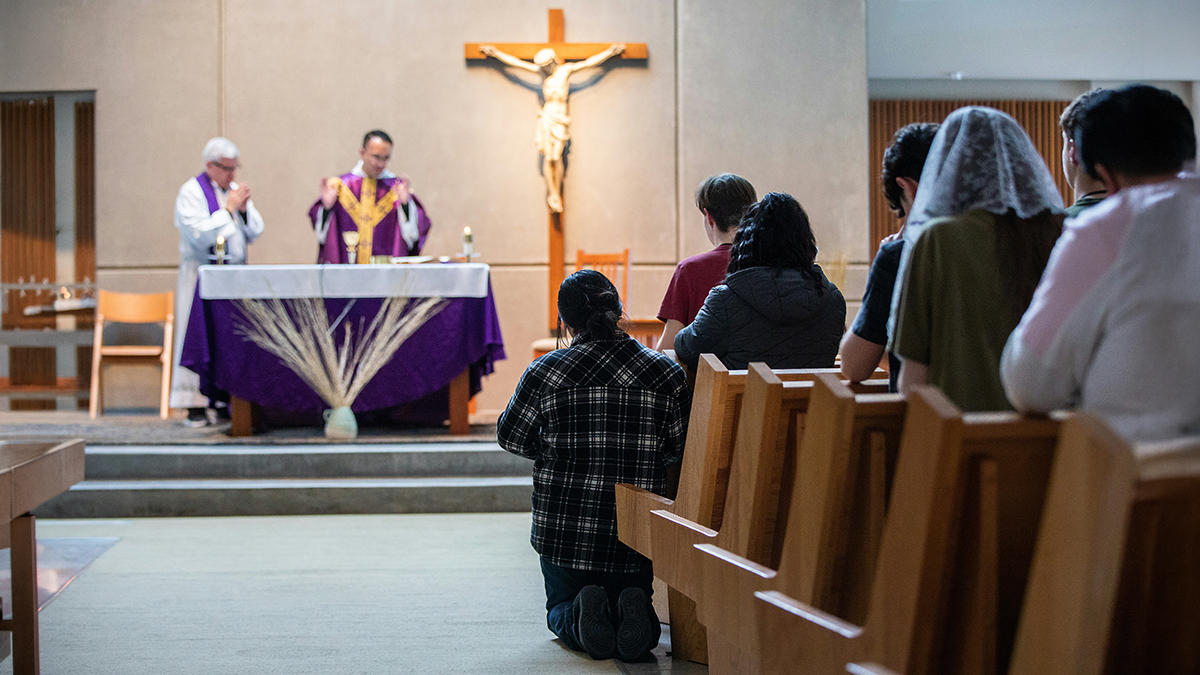
“Let us kneel before the Lord, our Maker!” The title of the pastoral letter by Sydney’s Archbishop Anthony Fisher, taken from Psalm 95, already hints at its content: the cleric wants to promote the importance of kneeling once again in his archdiocese.
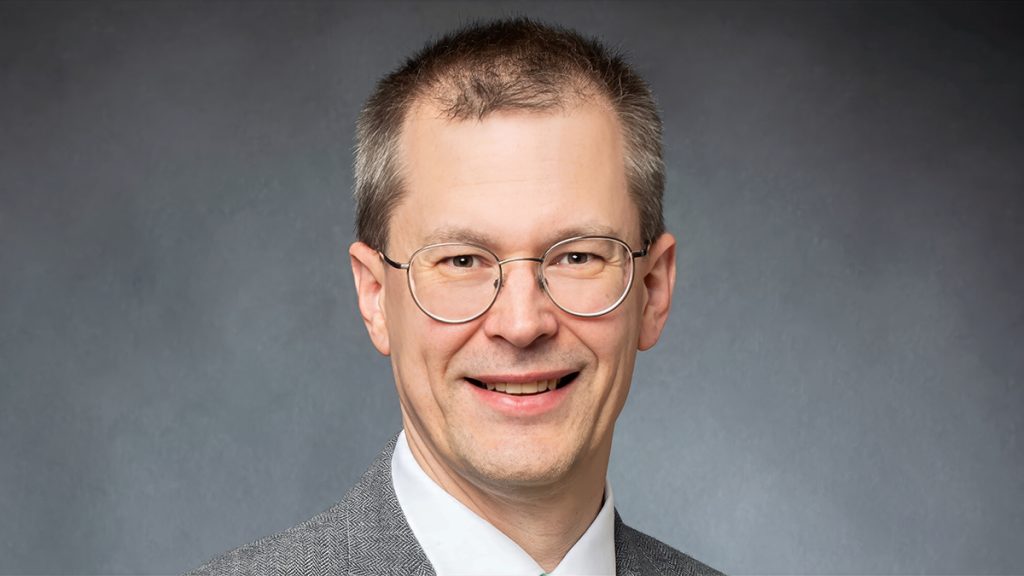
The Innsbruck liturgical scholar Liborius Olaf Lumma studies bodily postures in the liturgy. In an interview with katholisch.de, he explains why there should actually be less kneeling during Mass.
Christoph Brüwer: Mr Lumma, the Archbishop of Sydney strongly emphasized the kneeling posture of prayer in a pastoral letter. What significance does kneeling have in Catholic piety?
Liborius Olaf Lumma: It has a very great significance and a long tradition. But it is a comparatively late phenomenon that only spread, in the form we know today, toward the end of the first millennium.
But kneeling does have a biblical basis. Jesus, too, prostrated himself in prayer.
That’s true, there is a biblical tradition for it — but there is another, far stronger biblical tradition. And that one consists in the fact that human beings pray standing, stretching themselves out toward heaven with their gaze and with the posture of hands and arms.
Walking upright is something typically human, and the biblical imagery — like many other religious traditions — locates God above, in heaven, indeed: above the heavens.
Thus standing becomes, so to speak, the biblical standard posture for prayer: the human being stretches out, in his bodiliness, between earth and heaven.
Moreover, “kneeling down” in the Bible does not mean the prayer posture we know today in the Catholic Church.
Rather, it means throwing oneself flat on the ground with the whole body, or at least bending the body all the way down — similar to what we still know today in the Eastern Churches and in Islam, while it occurs rather rarely in Roman Catholic liturgies.
In biblical narratives, this gesture of prostration is reserved for quite specific occasions, for example experiences of guilt, grief, and despair, or when a person is, in the truest sense of the word, thrown to the ground by an overwhelming event.
Why Nicaea mattered
What, then, is the reason that kneeling was introduced in the Latin Church?
As far as I know, there is no source that specifically justifies or grounds it. But we can reconstruct that especially during the Carolingian period in the 8th and 9th centuries, when Western European Christianity increasingly adopted the forms of expression of the Germanic peoples, the notion was widespread that kneeling was a particularly appropriate posture toward God.
When a person makes himself small, he testifies to the greatness of God and worships God. It then evidently became very important to kneel as often as possible.
There are ecclesiastical regulations from this period that prescribe kneeling, for example, during the words of institution in the Mass — but not on Sundays.
Why?
Unlike in German, the biblical languages make no distinction between “standing up” and “rising from the dead.” That is why standing upright is, so to speak, a bodily expression of belief in the resurrection.
The First Council of Nicaea in the year 325 therefore prohibited kneeling on Sundays and throughout the Easter season. The underlying idea was, to put it pointedly, that someone who kneels does not take the belief in the resurrection seriously.
Nevertheless, as I said, kneeling gradually did make its way into the liturgy in the Western world, including on Sundays.
In Eastern Church liturgies, however, kneeling remains uncommon to this day, especially in the celebration of the Eucharist, because this always celebrates the redemption of humankind, who is raised up in the belief in the resurrection.
Kneeling down or throwing oneself to the ground is more of a personal, more spontaneous gesture of prayer; in the liturgy celebrated in common it occurs only on special occasions.
Are the different bodily postures differently “valuable”? Is kneeling more worthy than, for example, sitting?
Even today there is a tendency in the Catholic Church to regard kneeling as a particularly appropriate posture toward God, to be assumed as often as possible. But I would not speak of more valuable or less valuable here, but rather of different customs and self-understandings in dealing with one’s own body.
“Kneeling is
– Liborius Olaf Lumma
— as surprising as that may be
in our part of the world — not obligatory in the Mass. The Mass is celebrated standing.”
Standing as norm
But how does the Church see it? Is kneeling in the liturgy optional today, or are there also places where kneeling is obligatory?
Kneeling is — as surprising as that may be in our part of the world — not obligatory in the Mass. The Mass is celebrated standing. That is the basic liturgical posture.
On certain occasions sitting is provided for, which serves quiet listening, for example during the readings and the homily.
But there is then the provision that one should kneel for the words of institution, though one may also remain standing “for reasonable causes.” The newest version of the Missal in Latin formulates this “should” provision considerably more forcefully and extends it to the end of the Eucharistic Prayer, but only where this is the local custom.
But to newly introduce kneeling beyond the brief moment of the words of institution, or even to kneel continuously throughout the Mass, is not intended.
Why are there even different bodily postures in the liturgy at all?
Liturgy is a dynamic event with its own inner logic. The liturgy has focal points toward which it steers, and at the same time there are quieter phases in the liturgy. All of this is expressed and experienced with the body.
We are, after all, human beings with body and soul; the outer and the inner stand in relation to each other. The two cannot be separated.
The Second Vatican Council (1962–1965) explicitly demanded that bodily postures should also be put in order in the course of the liturgical reform. Bodily postures assumed in common are a bodily expression of the community in faith.
Incidentally, the liturgy actually requires more room for movement than is often possible in traditional church pews.
What do you mean by that?
Each individual person needs a certain area in which they can move back and forth and turn their gaze and their whole body in various directions.
When the bishop processes in through the main portal with the liturgical ministers, all those assembled should be able to turn toward this entrance procession. During the homily, everyone should turn toward the ambo; during the Eucharistic Prayer, toward the altar, and so on.
But church pews often do not permit such movements at all.
A step backward
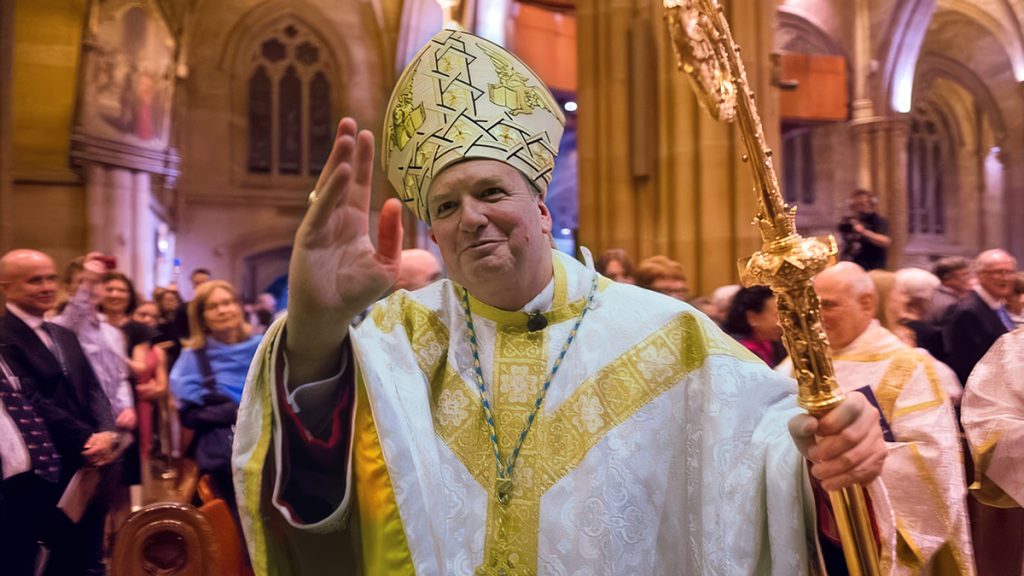
Archbishop Anthony Fisher came out in his pastoral letter in favor of reinstalling kneelers where they are no longer present …
From my point of view, it is an ecumenical step backward to want to broadly re-establish that, now that we have just rediscovered standing as the basic posture. This posture was especially important to early Christianity, long before the split between the Western and Eastern Churches occurred.
Permanently installed kneelers also restrict the body’s possibilities for movement in the liturgy. They would really only be needed in the brief moments of the words of institution, and why then should one not kneel directly on the floor, which in any case far better does justice to the original sense of prostration?
In my view, the development should go in a different direction.
So should Catholics not kneel anymore, as the Archbishop in Sydney wishes?
I think Catholics should, above all in the Mass, first and foremost rediscover standing, because that offers the possibility of connecting, with one’s own body and one’s own existence, to so many biblical narratives of the upright, raised-up human being.
Furthermore, standing in the liturgy is — going back to the First Council of Nicaea — the common ecumenical heritage of all the great Churches. That I consider the greater value, which absolutely should be rediscovered.
By saying this, however, I in no way want to disparage kneeling. It has its place where, in a concrete situation, one becomes aware of one’s own weakness and neediness and comes before God in his overwhelming greatness in adoration or supplication.
That can be in personal prayer at home or in church; it can also be communal, at eucharistic adoration, or at a penitential service or a blessing rite.
There is, however, a development in the Catholic Church that I find rather unfortunate.
Which one?
I find it very regrettable that in many parishes, of all moments, it is during the Eucharistic Prayer that so many different postures are assumed.
As a result, what is held in common recedes into the background, and the whole thing becomes a kind of demonstration of personal piety.
But that is precisely what the Council wanted to avoid. How this can be resolved will probably turn out differently from parish to parish.
In any case, it is a shame when, of all places, at the very center of the liturgy, a juxtaposition — sometimes even an opposition — of different gestures arises, instead of fostering the unity that is also experienced in bodily posture.
- Christoph Brüwer is editor at katholisch.de. Translated into English and republished with permission.