
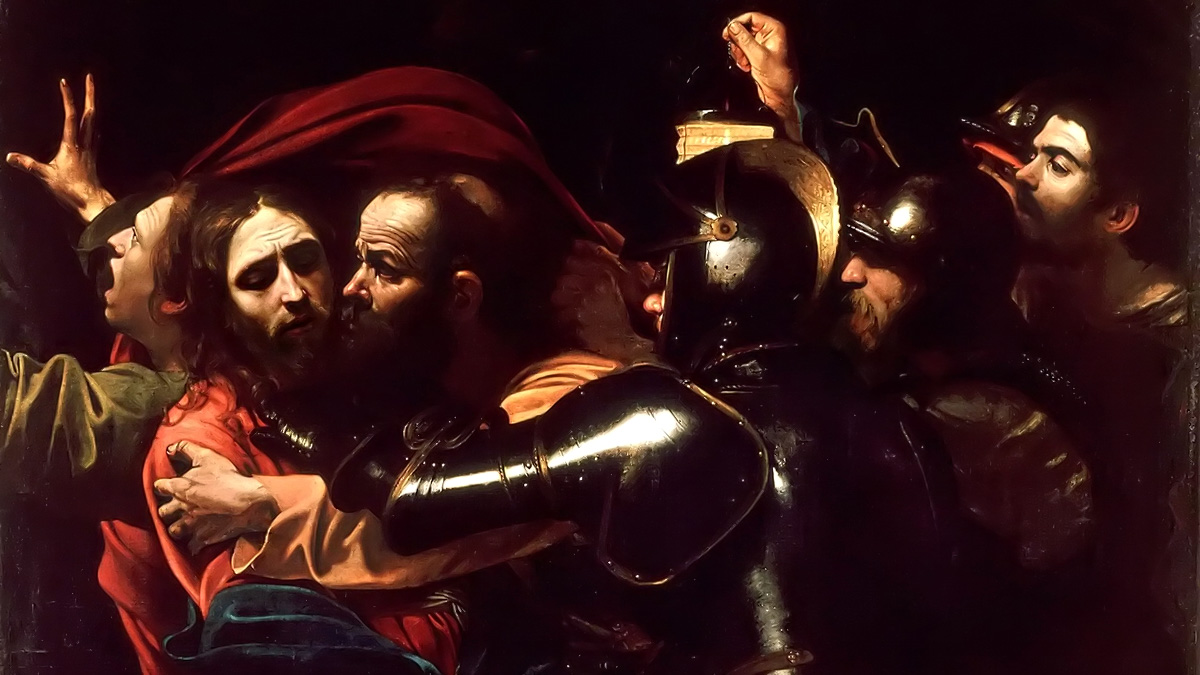
I didn’t see him at first. Only when I turned towards the last of Murillo’s six paintings on the Prodigal Son did his light catch my eye.
I was at Ireland’s National Gallery researching for The Journey Home, a restorative justice prison programme, grounded in the biblical story and Rembrandt’s magnificent portrayal of it.
Suddenly my research was forgotten as Caravaggio’s light in the Taking of Christ took centre stage. His representation offers an imaginative encounter with multiple questions and the discomfort of unknowing.
Questions in the light
Is it Caravaggio holding the lantern? What does he want and what can he see?
Who are the soldiers and what is their story? Is the light on their armour meant to act as a mirror for me?
Does the man running realise flight is now impossible? Who am I in this image or are they all me?
Perhaps you know the answers to my questions. You may have read or written biblical commentaries explaining the story.
You may be an art critic and know what the symbols mean and who the people are meant to be.
But authorised truth is never all there is to know in art, music and, dare I say, religion. If that were so, they would be systems of capture demanding conformity instead of doorways opening to more.
To journeys of exploration, new discoveries, delights and uncomfortable truths to weave into our unique journey home.
The lost Caravaggio
In 1921 Marie Lea-Wilson responded to this painting, then entitled The Betrayal of Christ. She was grieving for her husband who’d been assassinated by the IRA, and something about it – perhaps the light – drew her in.
By the 1930’s Marie was Dr Lea-Wilson, quite the achievement in those days. She gave the painting to “Fr Thomas Finlay SJ in gratitude for his friendship after the murder of her husband”.
60 years later, the painting was revealed to be the “lost” Caravaggio and is on permanent loan to the National Gallery of Ireland, where it found me.
Art behind bars
On The Journey Home, it now joins art by Rembrandt, Olga Fröbe-Kapteyn and Janknegt as the men in prison reflect on our weeks exploring restorative justice together.
Forgiveness has been central to those conversations. Not how the men can be forgiven, but how they could forgive others and, eventually, themselves.
They recognise the tragedy and tensions in Rembrandt’s life and the similarities to their own.
The men intuitively grasp that the characters in Rembrandt’s Prodigal Son are in all of us and how difficult it is to manage our unruly crowd to a peaceful integration.
With the reprobate Caravaggio, they can see that despite his tumultuous life, he was the expert at inviting the light in.
The interior journey
The journey home is not external; it is inward, to where our deepest fears and offences lie, covered in shame and self-loathing.
Underneath that dung heap is the eternal desire for healing, reconnection and forgiveness. Thank God for disreputable artists who paint themselves into biblical stories to give our unruly crowds hope.
- Sande Ramage loves exploring, one word at a time, what she and others mean by God, spirituality, and religion. She’s a healthcare chaplain, restorative justice facilitator, pastoral supervisor, and wordsmith. Inspiration arrives through pondering dreams in Jungian analysis, walking, movies on the big screen, live orchestral music, sopranos, and devouring books.