
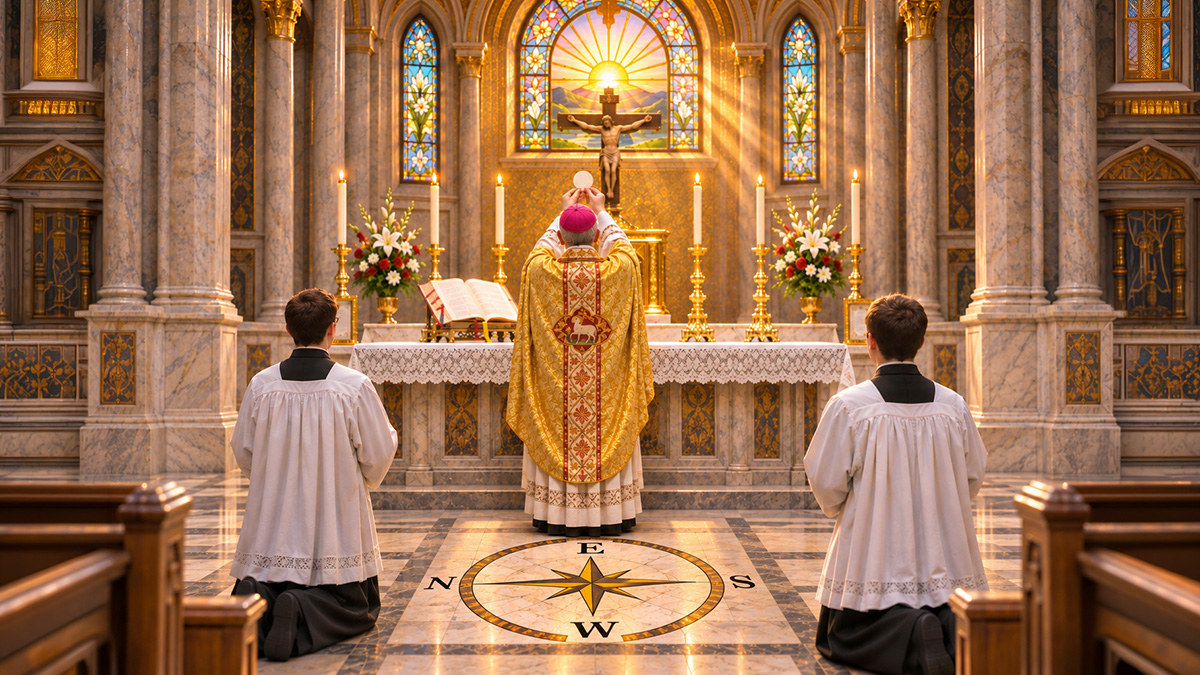
When a bishop or priest begins explaining a liturgical change with the words “my Mass”, alarm bells should ring.
Two words reveal a fundamental problem in the Church: the privatisation of its public worship.
The Mass is not his. It belongs to Christ and his Church.
Facing the Lord
Celebrating Mass ad orientem illustrates the problem, especially when its justification invokes the idea of “facing the Lord together”, suggesting that priest and people facing the same physical direction somehow express a more authentic orientation towards God.
But this is theological nonsense if it implies that a congregation celebrating versus populum is not already facing the Lord.
The Eucharist is directed toward the Father through Christ in the Holy Spirit, not through the priest’s geographical orientation. Christ is present in the Eucharistic assembly, the proclaimed Word, the ordained minister, and the sacramental species (Sacrosanctum Concilium 7).
Turning the priest around does not make Christ more present.
Nor does it eliminate clericalism. It may simply turn clericalism around.
Preference versus participation
The deeper problem is the assumption that an ordained minister’s personal liturgical preference provides sufficient justification for changing the ritual experience of an entire community.
The Second Vatican Council explicitly teaches that liturgical celebrations are not private functions but actions of the whole Church (SC 26). It also prohibits anyone, including priests, from changing the liturgy on personal authority (SC 22 §3).
Authority is not ownership
Of course, ad orientem is a legitimate liturgical practice. Bishops possess real authority, and the liturgical books permit certain choices. But permission is not pastoral justification, and authority is not ownership.
A significant change in established worship deserves consultation, explanation, and genuine faith formation. The faithful need more than an announcement explaining what the priest intends to do. They need to understand why the change matters for their participation in the Eucharistic mystery.
This is not about submitting liturgy to majority vote. It is about recognising the baptismal dignity of those who constitute the worshipping assembly.
Here lies the extraordinary irony. A bishop may claim to be correcting priest-centred worship while exercising precisely the clerical control that makes the priest the determining subject of the celebration.
Such thinking perpetuates a pre-conciliar clericalist mentality in which the priest acts, and the people follow. It contradicts the Council’s fundamental insistence on actuosa participatio: the full, conscious, and active participation of all the baptised (SC 14).
Servant or proprietor
The issue is not whether the cleric faces east or faces the people. Both orientations can express authentic worship if they genuinely reflect active participation. However, both can also accommodate clericalism.
The question is whether the priest understands himself as the servant of the Church’s liturgy or its proprietor.
The Church does not need clergy who claim to face the Lord while disregarding the people with whom they celebrate.
The real direction of liturgical reform is not geographical. It is for the Church to decide.
The Mass is never “my Mass”. It is always the Eucharist of Christ and his Church.
- Dr Joe Grayland, a priest of the Catholic Diocese of Palmerston North, New Zealand, is a lecturer in the Department of Liturgy at the University of Wuerzburg (Germany).