
The Second Vatican Council accomplished much in reforming Catholic liturgy and the theology and practice of the ordained ministry.
On the former, the Council Fathers affirmed clearly that the liturgy is the work of Christ celebrated by the Christian people, a baptized priesthood.
On the latter, the “Decree on the Ministry and Life of Priests” (Presbyterorum Ordinis) appropriately dealt with the ministerial role of priests before their identity. It nicely balanced the threefold role of the priest in line with Christ’s own threefold office: priest, prophet and king.
At the same time, the Council did not achieve a coherent theology of the priesthood in line with the importance of the baptismal priesthood. Nor did it take modern advances in eucharistic theology and liturgical scholarship into account.
Tomorrow’s priests will not be
John Baldovin
those who derive their power
from a socially powerful church,
but who rather have the courage
to let the church make them powerless.
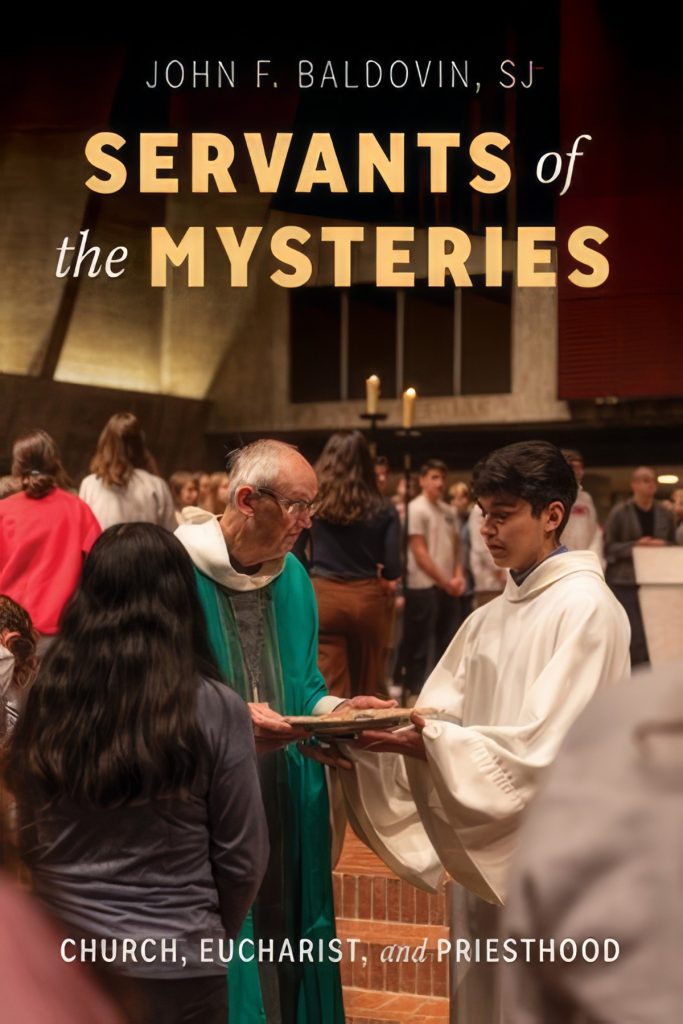
My book, “Servants of the Mysteries: Church, Eucharist and Priesthood,” is meant to bring the conversation about the priest in relation to the Eucharist forward.
I begin with a chapter on the Eucharist itself. I argue that theological reflection on the priesthood should start with how the assembled church participates in Christ’s total self-sacrifice to the Father.
It is within eucharistic sacrifice, the celebration of the Paschal Mystery, that Christ’s real presence can be affirmed.
That belief has attracted much attention today. But it needs to be contextualized by the fact that Eucharist means celebration before it means the consecrated body and blood received in communion. Eucharist is a verb before it is a noun.
Communion with Christ and in his Church is the ultimate aim.
I also argue that the Lord’s words — “This is my body…” — are not a formula of consecration so much as a central moment within a complete eucharistic prayer. That prayer also asks the Holy Spirit to consecrate the bread and wine and to enable us to manifest Christ’s presence for the world.
Priesthood does not exist for itself
John Baddovin
and no respectable person would say that it does.
In light of that understanding, I consider the relation between the priest acting in persona Christi capitis and in persona ecclesiae. The priest acts in the person of Christ, but not independently of the Church. He acts in persona Christi insofar as he acts in persona ecclesiae.
I owe much of this theology to Edward Kilmartin, S.J.
I then discuss the theological and pastoral consequences of these programmatic chapters:
Chapter three: What is the priest’s role in offering Mass for an intention, and how are personal intentions incorporated into the offering for the salvation of all?
Chapter four: The Council permitted concelebration as a sign of unity and an antidote to private Mass. But given the previous chapter’s argument, must priests concelebrate regularly? Historical studies show that concelebration by priests alone, without a bishop, is a total innovation.
Chapter five: Does a priest need to preside at the Eucharist daily?
Chapter six: Since liturgy communicates in an embodied way, what is the proper “choreography” of the liturgy? This includes the advantages and disadvantages of versus populum versus ad orientem celebration, and the most appropriate postures, gestures and presiding actions in light of the whole prayer as consecratory.
I conclude with a theological and pastoral reflection on the ars celebrandi and spirituality of presiding. It draws heavily on Pope Francis’s apostolic letter, “Desiderio desideravi” (2022).
I believe the traditionalist trend among Roman Catholic clergy overemphasizes the priest’s role in the Eucharist.
I hope “Servants of the Mysteries” helps stem that trend and offers a coherent theology more in line with our appreciation of the common priesthood of the faithful.
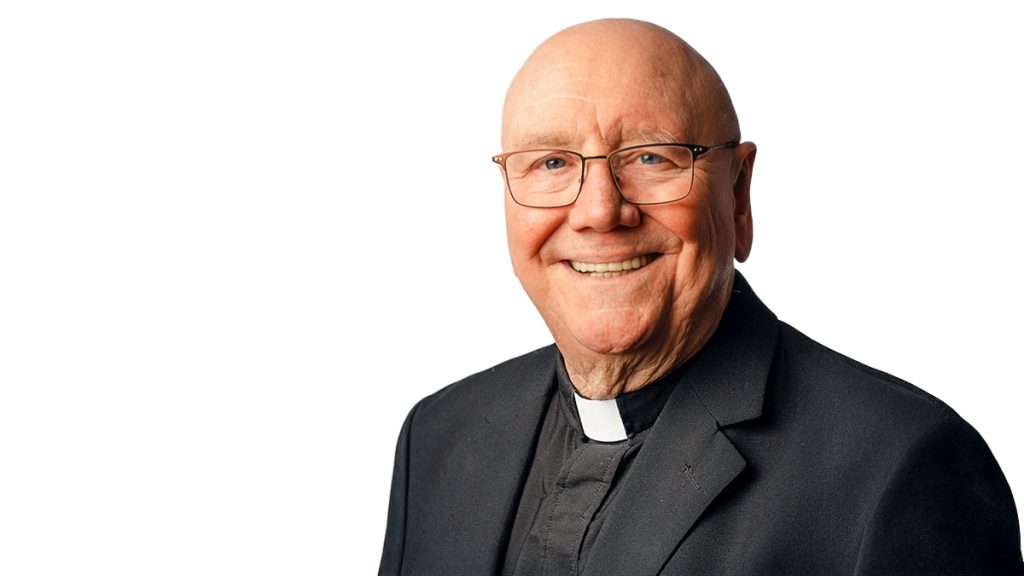
- John Baldovin SJ, is professor of historical and liturgical theology at the Boston College Clough School of Theology and Ministry. He served on the advisory committee for the Bishops’ Committee on the Liturgy of the USCCB (1989-1993) as well as the advisory committee of the International Commission on English in the Liturgy (ICEL) from 1994-2002. He is past president of the North American Academy of Liturgy as well as Societas Liturgica. He is former president of the International Jungmann Society for Jesuits and the Liturgy and the author of Reforming the Liturgy: A Response to the Critics published by Liturgical Press.He has been teaching ministerial students for over 40 years.