
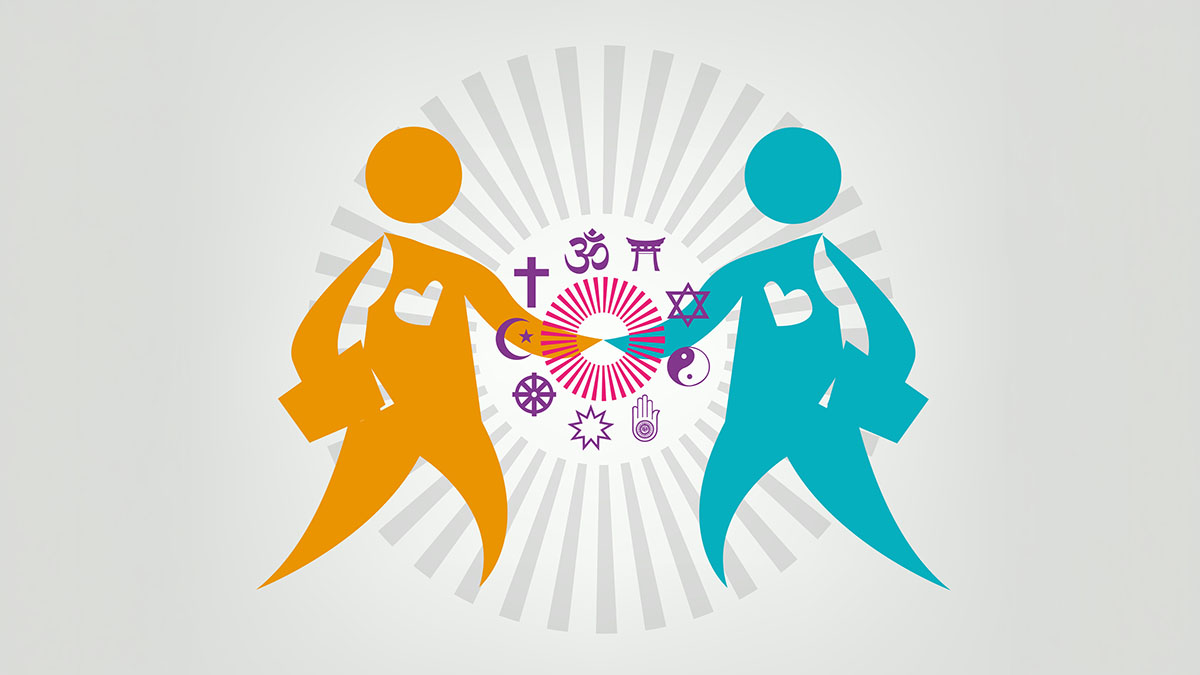
Living alongside other religions might appear to be far from the issues we are discussing now in terms of synodality.
But if we do not keep in mind that we share this planet with many faiths, then we might just become a little sect rather than be witnesses to the good news.
Here is where the study of theology can help us clarify who we are – and how we relate to others.
Theology is a door to a greater level of human understanding.
A more complex world
Just a generation ago many Christians lived in societies where everyone they met was either a Christian or someone who rejected Christianity.
Today most Christians live side by side with people from a variety of religions; indeed I can keep track of the variety of religions where I live by watching the way that the local supermarkets try to cash-in on festivals.
There is Christmas and Easter for Christians; Passover and Hanukkah for Jews; Eid for Moslems, Divali for Hindus; and – in the last few years – Halloween (originally an Irish Christian festival) for anyone else!
We live in a multi-faith world and there is little chance that anyone can think that there is only one way of thinking about the Big Questions of live, death, love, meaning, and purpose.
But there lies the heart of it; we all are concerned with these questions – and humans have been concerned about them, and consequently engaged in ritual and religion, since our very earliest evidence for humans on this earth.
What does this fact – that all human societies and cultures ask the great religious questions – mean for us as Christians?
Marketplace logic pitfalls
It is very easy to take the logic of the marketplace and transfer it to questions of religions (the proof of this is how endemic is the notion among Christians that we can buy our way into heaven) and it can confuse us at a very deep level.
If I need to change a punctured wheel, I need either to have a jack or buy one.
If I get a jack and use it, then the wheel gets changed. The opposite is also true: no jack, wheel cannot be changed!
This is a good piece of clear, logical thinking.
Alas, I might try to use this same thinking in matters of religion.
The starting point seems clear enough: if I follow the Christ, the way, truth and life, I can look forward to new life with him in the presence of God the Father.
This is a true and simple statement of Christian hope.
But what if I tried to expand on it? I might try to reverse it and then I would say ‘if I do not follow the Christ, then I cannot look forward to new life.’
But what if I tried to make it more abstract: ‘Disciples of Jesus can look forward to new life’ – again this is a very blunt, but still true statement.
This too can be true, because following the Christ as a disciple is a costly business, and I could reject God’s love.
But can it be reversed? Then it would become ‘no new life unless you follow Jesus’ or ‘only followers of Jesus can get to new life.’
Both these statements have often been made – and many have tried to present Christianity in terms of ‘faith’ on one side, and hell and annihilation on the other.
Limits of mercy
But these statements are false: we cannot try to limit God’s love and mercy; we cannot be true to a God who is love and preach such an either/or vision of rewards/punishments.
The fundamental problem is that we have transferred what is efficient thinking within the finite world into the realm of mystery and the Infinite.
That is not only sloppy, but leads to falsehoods.
Respecting every religion
All those various celebrations advertised in the supermarket are all a response to the mystery of God who created the whole universe and each of us and who loves each of us.
We may have insights into the nature of the divine that we want to share with all, we may want to build the great family of the People of God in peace, but we do not ‘bring God’ to people: God is already present in every human heart, every word of prayer in every religion is a praise of God, and we must respect each searching after the divine as part of the precious treasure of humanity and as a something sacred.
Religion is viewed by many today as the great distraction and the great sower of discord; part of the Christian message is that God is present to each and so, respecting God’s presence in every religion we can build discourse.

We all think about the questions of religion – but usually do so in a very confused manner.
Theology can help us do it better – and the more ably we think about religion, the more we can replace discord with discourse.
Religions can learn how to respect one another, speak to one another, and learn from one another – all to the glory of God.

- Thomas O’Loughlin is a presbyter of the Catholic Diocese of Arundel and Brighton and professor emeritus of historical theology at the University of Nottingham (UK).