
Recent editions of Flashes have discussed the virtues of standing rather than kneeling during the liturgy. We’ve had ‘Restoring kneelers!’ (23 June), ‘When kneeling divides rather than unites‘ (30 June), and ‘Standing to pray: sign of a priestly people‘ (7 July).
The authors all want us to stand before God.
If space permits, standing in a circle before God can be even better.
I experienced standing in a circle most recently in Berlin. It was a Church of England Eucharist in the (Lutheran) Marienkirche, a medieval church in the heart of the tourist centre.
Although there is a regular Sunday evening congregation, inevitably in such a gathering there are visitors, of whom I was one.
In the pews, we sang hymns from the Revised English Hymnal and followed the Common Worship service. The sermon was delivered from a flamboyant baroque pulpit, supported by angels and cherubim.
Gathering in a circle
Then we were invited to gather in a circle in the spacious area behind the altar. A small choir stepped forward and sang an anthem.
The bread and the cup were administered around the circle. Some prayers were said.
It was entirely different from quickly nipping up to the altar rail, and back to one’s seat. In the circle, I felt a tangible sense of connection with these strangers – people from many parts of the world, united by a desire to worship through the medium of English on a summer evening in Berlin.
Circular spaces in Berlin
Large amounts of ecclesiastical rebuilding in post-War and post-Wall Berlin have created some profoundly moving circular spaces. St Hedwig’s RC Cathedral, originally built in the mid-eighteenth century, was re-designed between 2018-24.
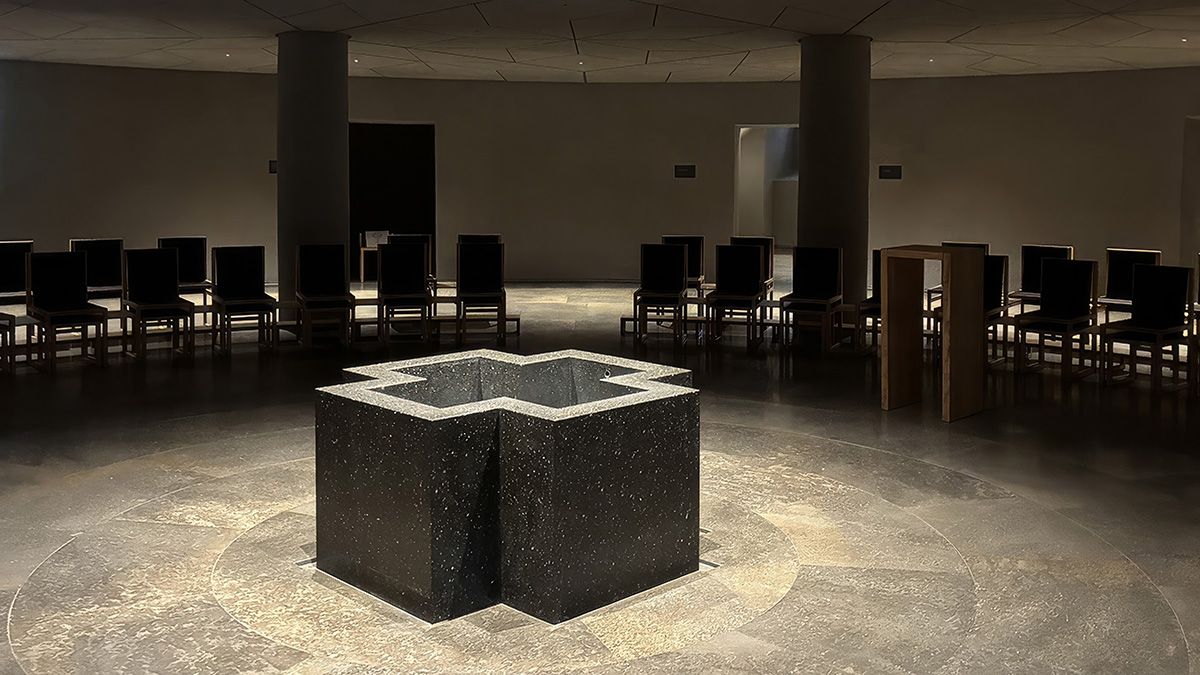
There is a central font, large enough for full immersion, in the crypt, and a central hemispherical altar in the main body of the church. Congregational seating is arranged in concentric circles, and the bishop’s seat is integrated into the congregation.
The Cathedral has many intriguing features, including a Space of Repentance, with a mirror and an upturned prayer stool. Every centimetre of St Hedwig’s resonates with theological intention.
The Chapel of Reconciliation
Arresting in a different way is the oval shaped Chapel of Reconciliation (1999). It replaces a church that became trapped within the outer and inner sections of the Berlin Wall, and was blown up in 1985.
Made from clay, it incorporates some of the rubble from the previous church. Its rough-hewn texture is strongly reminiscent of the Wall, which survives in small sections nearby.
Outside, in what was once the Death Strip surveilled by snipers in watchtowers, the parish have planted a field of rye. ‘Where it is possible to sow, there is peace’.
Berlin teaches many lessons.

- Frances Knight is Professor Emeritus in the History of Christianity at the University of Nottingham, where she previously served as Head of Theology and Religious Studies and Director of the MA in Church History. A former President of the Ecclesiastical History Society, she is now a freelance historian, academic consultant, and Co-Director of Samaritans of Aberystwyth and Mid Wales.