
Seven years ago, a Pew survey1 seemed to catch American Catholic leadership off guard when it revealed that only 31 percent of self-identified Catholics checked the box indicating that they believed that the bread and wine actually become the body of and blood of Jesus Christ (after priestly consecration).
The rest—69 percent—responded with the answer that these are symbols of Christ’s body and blood.
In a manner unanticipated by the average Catholic churchgoer, the American bishops took the matter to heart and wrestled with why popular Catholic opinion better tracked in a Baptist direction—that is, as the bread and wine as a symbol—than toward Rome.
The American bishops certainly took the 2019 study more seriously than on previous iterations of such surveys.
They responded with a three-year National Eucharistic Revival (2022-25) that sought to renew and spread belief and devotion to the Real Presence of Christ in the Eucharist, which is a matter of Catholic doctrine—indeed, a dogma—not merely a preference.
It concluded in July 2024 with Eucharistic processions launched from the West and East coasts, the Texas border with Mexico, and northern Minnesota.
Each procession descended, after weeks in transit, upon Indianapolis, where during five days that July nearly 50,000 Catholics participated2 in events that reinforced the Church’s teaching on the topic.
It was the 10th such congress in the U.S. Church’s history, but the first in 83 years. (The next is scheduled for 2029.)
In a new study appearing this month in the journal Sociological Inquiry,3 a pair of colleagues (Brad Vermurlen and Anne Morse) and I reveal what, if anything, has changed using a random sample of 1,049 self-identified Catholics.
The question was part of a larger, nationally-representative survey of 5,400 American adults fielded in September 2025 using Ipsos’s KnowledgePanel® survey participant pool.
Little has changed
What rate of belief in the Real Presence of Christ in the Eucharist did our latest evaluation yield?
The answer: 29 percent.
In other words, no statistically-significant difference from the 2019 Pew survey’s estimate of 31 percent.
Indeed, has anything changed notably among American Catholics since 1992, when a Gallup poll of American Catholics revealed that 30 percent endorsed a similar statement?
At face value, not really.
Why?
What does it all mean?
How was this latest assessment constructed?
In this newest iteration of such studies, 1,049 self-identified Catholics (regardless of present religious behavior) were posed this question:
“Do you believe that when the priest consecrates the host during Mass that the bread and wine are transformed, actually becoming the body and blood of Christ, or do you believe the bread and wine are symbols of his body and blood, or are you not sure what happens?”
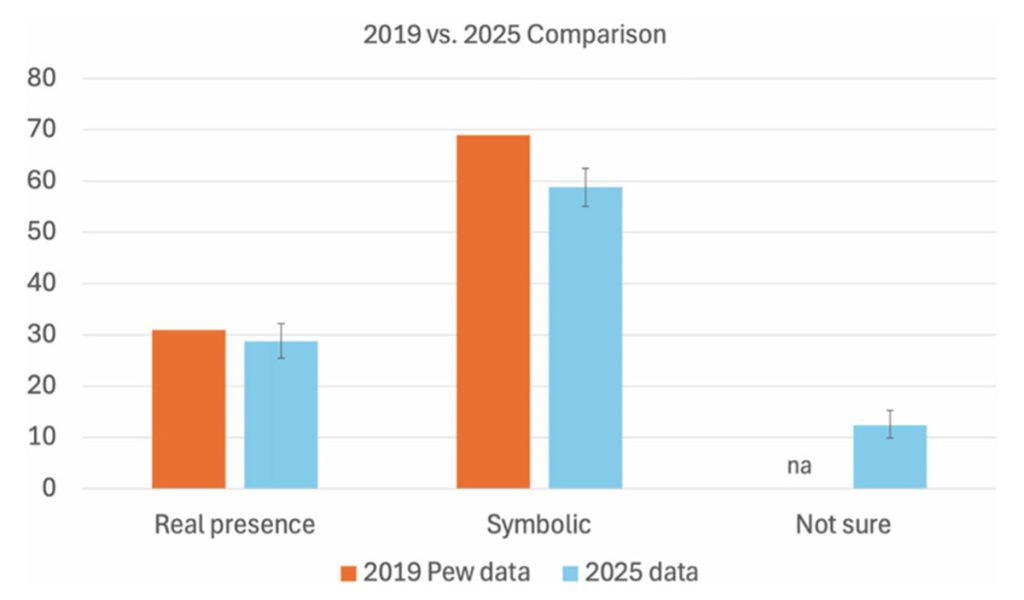
American Catholics’ Belief about the Eucharist, Comparing 2019 Pew Data and Data from the Austin Institute’s 2025 Relationships in America Survey. 95% Confidence Intervals Shown.
Respondents could select one of three (restated) options:
- “I believe the bread and wine truly become the body and blood of Christ”;
- “I believe they are symbols of Christ’s body and blood”; or
- “I’m not sure what happens.”
Only seven respondents elected not to answer at all.
For every respondent who answered “I’m not sure,” nearly six chose the “symbols” answer.
Every attempt at measuring Catholic opinion on this matter has had its critics.
Some have disliked this or that survey question wording or the available answers to the question posed.
Past assessments complained about a “false opposition” between answer options, confusing those who might perceive more than one to be true—or both false.
Others have taken pains to claim that fine-tuned theological subtleties in the question or answers make a difference.
We’re skeptical that these matter when you are posing the question to average American Catholics.
Was ours a replication of a previous question and answer sequence?
Not exactly—and I realize that can affect direct comparability.
I altered the question slightly because I wasn’t satisfied with the way similar questions were posed in previous efforts. (The most significant thing was to add an “unsure” answer.)
And yet here we are, having all but replicated the famous 2019 Pew survey’s results.
Religiosity drives belief
One of the key reasons I’m convinced that subtleties in question-wording are not very consequential here is because of what we learned about those who assert a belief in the Real Presence versus those who do not.
Herein is the real story—and it’s not surprising: such beliefs are highly correlated with measures of religiosity, particularly at the top end of the scale.
Without additional controls, around 60 percent of weekly (and a little under 70 percent of more frequent) attendees profess belief in the Real Presence.
That’s more than double the overall rate when we include all Catholics.
But subjective (i.e., private) religiosity matters even more: three-quarters of those Catholics who say that their religious faith is “more important than anything else” also profess belief in the Real Presence.
Compare that with the next highest category—those for whom religious faith is “very” important: only 40 percent so believe.
In subsequent analyses not included in the published study,4 I sought to “maximize” the predictable conditions for belief in the Real Presence by requiring multiple indicators of Catholic religiosity: at least weekly Mass attendance, religious faith is “more important than anything else,” and the respondent reported having attended Mass the past weekend (which was something of a check on a general attendance measure historically prone to overestimates).
Of those respondents who met all three of these thresholds, 88 percent report belief in the Real Presence.
It’s high, and that makes sense.
Remember: no measure typically reaches 100% in real life data.
Indeed, apart from religious measures, there is very little that predicts different answers to the question about the Eucharist.
Income doesn’t matter, nor does being a man or woman.
Nor does age, race, or ethnicity.
Where you live in the United States doesn’t matter.
Even political self-identity doesn’t matter.
This is good news; as the priest poet Gerard Manley Hopkins once penned, “Christ plays in ten thousand places.”
It’s good to know that a central belief—while unfortunately a minority among Catholics—is not characteristic of some locations and demographic groups more than others.
There are a pair of exceptions: Marital status barely matters—and that only among the divorced, who are slightly less likely than married persons to believe in the Real Presence.
And having a college degree was the only educational distinction noted—but in favor of belief in the Real Presence rather than skepticism about it.
Clarity in instruction
If education is the only “secular” predictor, then an obvious take-home message here is more clarity in instruction—teaching the faithful what the Church holds to be true.
Indeed, only recently did I hear a priest offer a homily explaining the problems with in vitro fertilization (IVF).
The homiletic default is often to avoid discussing anything that creates controversy, confusion, or makes a priest’s life more difficult.
But in a world wherein Catholics are saturated with information—and hence competitors to orthodox belief—it is incumbent on priests to remind parishioners what the Church holds to be true theologically (and socially, etc.).
Unfortunately, the study’s analyses also reveal that those who most need it aren’t likely to be present and listening.
Catholics who don’t attend Mass very often tend not to think a whole lot about Catholic matters.
Some, but not very many, may be conscientious objectors—firm in some matters of faith but objecting to a variety of core teachings (like the rejection of artificial contraception, for example).
But since the Council of Trent (in 1551) the Real Presence has not only been a doctrine but a dogma as well; that is, it’s fundamental to the faith.
Conscientious objection to dogmas isn’t the stuff of flexibility.
A lingering mystery
One aspect of the search for an explanation of why only around 30 percent of Catholics believe in the Real Presence remains invariably a mystery.
I am talking about how our predictive measures—including religious activity and fervor—only account for perhaps one-quarter of the variation in belief about the Eucharist.
This is not unusual across the social sciences, where I am constantly reminded about how the actions, attitudes, goals, challenges, difficulties, and hopes of people are tough to predict with confidence and accuracy.
People—the subject of our studies—are different than we often expect.
They know less (or more) than we anticipate, and don’t act (or do) as we expect, and maintain beliefs that shock (or impress) us.
I once didn’t believe in the Real Presence myself.
I do now.
It is still mysterious.
And I understand why many don’t believe it, Catholic or otherwise.
Are Catholics who deny it intentional in their denial?
Some, perhaps, but I suspect most are not.
Rather, it is apt to be a casualty of average Catholic disengagement.
What we need now is the remedy—evangelism, clarity, and explanation.

- Mark Regnerus is a professor of sociology at the University of Texas at Austin and president of the Austin Institute for the Study of Family and Culture.
- First published on What We Need to Know as Substack by Mark Regnerus. Republished with permission.
- Gregory A. Smith, “Just one-third of U.S. Catholics agree with their church that Eucharist is body, blood of Christ,”Pew Research Center,August 5, 2019. ↩︎
- Ruth Graham, “Eight Decades Later, a Celebration of Faith Renewed,” New York Times, July 21, 2024. ↩︎
- Brad Vermurlen, Mark Regnerus, and Anne Morse, “Belief in the Real Presence Among American Catholics: Prevalence and Patterns,” Sociological Inquiry, 96 (2026): e70067. ↩︎
- Ibid. ↩︎