
‘Grant that we who worship Christ in this holy mystery may reverence him in the needy of the world by lives poured out for the sake of that kingdom.’ Opening Prayer B, Feast of Corpus Christi. 1989 Roman Missal.
Among the pastoral messages issued for the feast of Corpus Christi was a letter from the archbishop of Sydney hosting the 28th Eucharistic Congress, entitled Adoring the Eucharistic Lord: ‘Let us kneel before the God who made us.’
After a careful reading, its central claim seems to be that ‘kneeling most clearly reveals what we believe about God and our relationship to Him.’
Scripture and tradition
Archbishop Fisher defends his view from both scripture and tradition. Yet the biblical and historical theologian Professor Liborius Olaf Lumma points to a more ancient posture: ‘people praying while standing, stretching themselves toward heaven with their gaze and with the posture of their hands and arms.’
Fisher’s letter lists the moments when we kneel at Mass: genuflecting as we arrive and leave; throughout the Eucharistic Prayer; and again as the host is broken and we ‘behold the Lamb of God.’
Then personal preference comes into play.
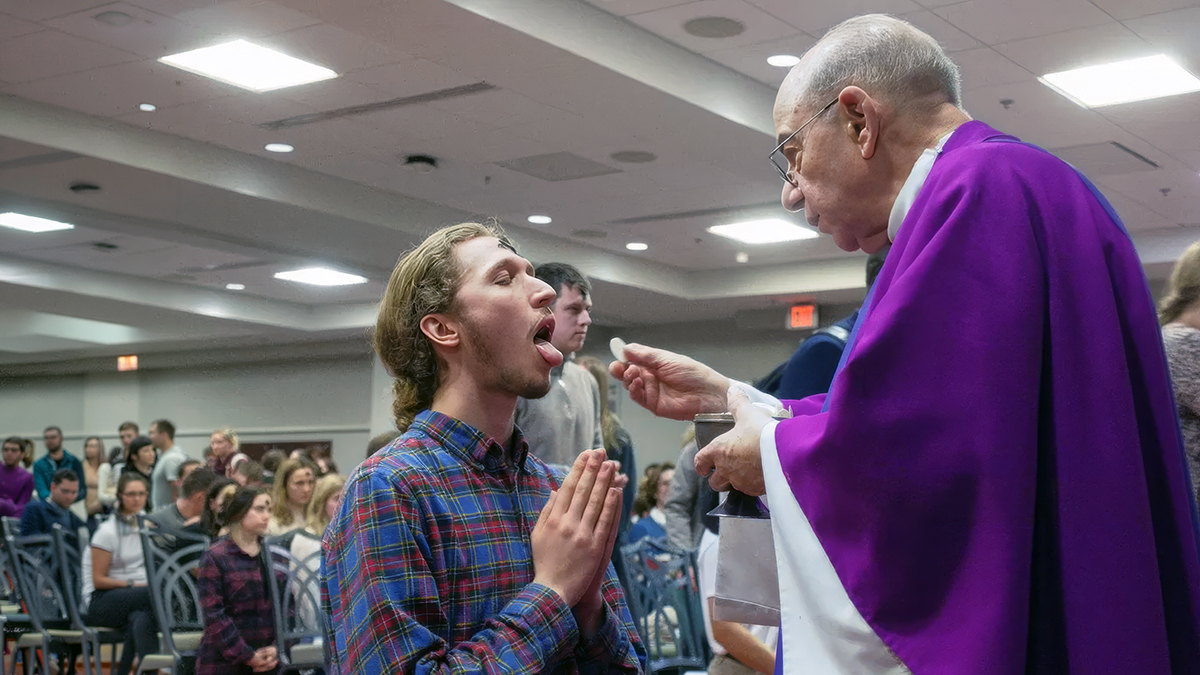
The archbishop commends kneeling to receive Communion as ‘a perfectly valid option envisaged by the current Missal,’ and reminds us it was ‘the default position of receiving communion in the Latin church for many centuries.’
A question of unity
Kneeling to receive remains permitted; no communicant may be refused for it.
But permitted is not the same as advisable, and the letter does not explain why standing became the norm — nor what is gained by encouraging a return to the older practice.
That norm is not an accident. A key principle of the liturgical reform of the Second Vatican Council is unity.
The General Instruction of the Roman Missal (GIRM) directs that the Communion chant express the unity of the communicants (GIRM 86), as does a uniform bodily posture (GIRM 42).
The sign of the one body approaching the one table is surely weakened when some kneel to receive while the majority stand.
Standing as the norm for Communion is, moreover, the determination of the bishops’ conference — not a matter of private taste, but a deliberate expression of that unity.
On removing kneelers
A further claim in the letter was new to me.
The archbishop reports that some Catholics consider kneeling ‘degrading,’ ‘grovelling,’ ‘unbecoming of the children of God,’ and suggests this may be why church leaders removed kneelers from pews and confessionals, and even instructed people not to kneel.
I am not aware of kneelers being removed.
Where new churches were built or old ones renovated without them, those responsible were more likely guided by the church’s own tradition — the tradition Professor Lumma describes.
‘Standing upright is, so to speak, a bodily expression of belief in the resurrection. The First Council of Nicaea in the year 325 therefore prohibited kneeling on Sundays and throughout the entire Easter season’ (Canon 20).
Someone who kneels at those times, in this view, ‘is not taking the belief in the resurrection seriously.’
Archbishop Fisher has now instructed Sydney clergy ‘to restore kneelers in every church where they are missing.’
Yet for decades these assemblies have exercised their priestly duty as resurrected Christians by standing for the Eucharistic Prayer and for Communion. Rather than fostering unity, a return to kneeling — heeded unevenly — risks leaving the assembly divided at the very moment it should most visibly be one.
Kneeling before the poor
Meanwhile, Pope Leo celebrated Corpus Christi — kept locally as the day of charity — in Madrid. He too spoke of kneeling, but before God and our neighbour, because ‘the Christ who processes through the streets in the monstrance is the same one who identifies with the poor, the downtrodden, those who are alone and forsaken.’
Replacing kneelers may matter to some. But Leo’s call to ‘reverence Christ in the needy of the world’ — the altar on which we are truly to offer sacrifice — is surely the weightier concern.
- Carmel Pilcher RSJ, PhD is a Liturgy and Culture Consultant and Educator, Darug and Gundungura country.