

Increasingly, I hear it said that abandonment of Christianity is a sign of sophistication, education and social maturity and that faith in God is an insult to one’s intelligence and a sign of emotional instability.
Moreover, Christianity has been responsible for so many atrocities that it has forfeited any claim to moral leadership.
Where the fault lies
Religion, it is true, has much to answer for. Not religion as such, but its misuse.
At fault are extremists who wrench particular texts from their historical and cultural environment and perversely enlist them to justify exclusion, intolerance and condemnation.
What authentic faith offers
In response, we must acknowledge and celebrate authentic Christianity.
First, it encourages meaningful engagement with questions about life beyond the limits of our immediate experience. Its chief commandment is love.
It sets guidelines for living effectively in community. It promotes peace with justice as the loving basis of relationships.
It invites care and respect of neighbour and does not restrict neighbour to those of similar nationality, religion, social standing or attitudes. Neighbour is anyone who happens to be around.
It advocates sacrificing self-interest for the good of others. It offers a transcendence that takes us beyond the ordinary and all that demeans and destroys.
It offers the assurance that, in the face of tragedy, illness, failure, and death, we are free from the fear that these will destroy the value and meaning of our lives.
It testifies to a sure ground for hope, purpose and dignity in life, even in the bleakest circumstances.
The agnostic’s limits
The agnostic is free to argue against the Christian faith, but not that the Christian vision of human life stretching beyond time and space is smaller than one that sees it ending in a handful of dust.
Or that belief in the eternal value of life is less worthy than regarding it as a transitory blip in a meaningless universe.
Or that Christian social justice initiatives have not significantly improved the human condition.
Or that the Christian faith has not inspired the finest scholarship, art, sculpture, architecture and music, and continues to do so.
To denigrate the belief that human beings are infinitely precious to God, reflect his nature, which they’re born to share, and can, by grace, become united with this loving source of life and inspiration, is hardly a matter for self-congratulation, but rather for mourning.
Not a prison break
For some, abandoning religious belief may seem honest and honourable, but it’s not exactly jumping over a prison wall.
It’s more like jumping into a dustbin. Not a grand illumination, but more like switching off the lights.
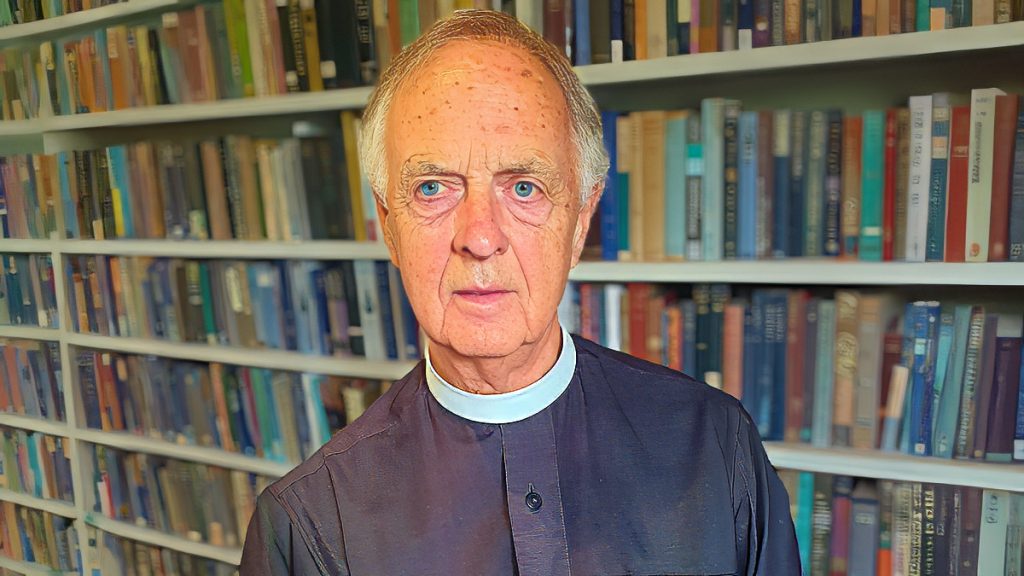
- John Shepherd is the Emeritus Dean of Perth, Western Australia. He has a doctorate in sixteenth-century theology and music from Cambridge University, a Master of Sacred Music degree from Union Theological Seminary in New York, and degrees in arts (history and philosophy) from the University of Melbourne.
- In 2019 Dr Shepherd was Interim Director of the Anglican Centre in Rome and the Archbishop of Canterbury’s Representative to the Pope and the Holy See.