
What is happening in our churches today regarding the meaning and celebration of the fraction rite accompanied by the Agnus Dei? (Lamb of God.)
Do we see presiders actively breaking the one bread in full view of the assembly, proceeding through this rite with reverence, care and meaning?
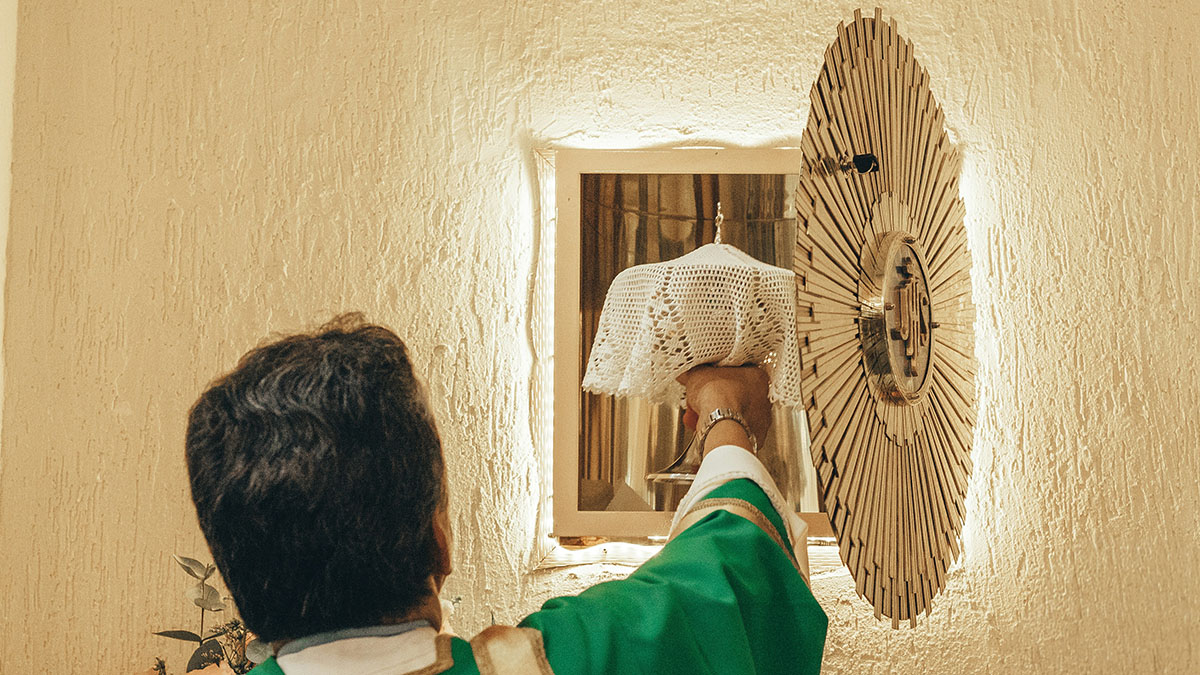
Sadly, more often, we see this rite fade into the background as the acolyte or deacon takes the intoning of the Agnus Dei as a physical cue to proceed to the tabernacle.
A forgotten fraction rite
Giving full reverence to the blessed sacrament receptacle, they then return to the altar with hosts consecrated at a different Mass, with a different gathered assembly.
What may follow is a reorganisation of hosts across a number of ciboriums – and the fraction rite is overtaken by a re-distribution of hosts foreign to this celebration.
What the GIRM says
The General Instruction of the Roman Missal clearly states (85):
It is most desirable that the faithful, just as the priest himself is bound to do, receive the Lord’s Body from hosts consecrated at the same Mass and that, in the instances when it is permitted, they partake of the chalice (cf. no. 283), so that even by means of the signs Communion will stand out more clearly as a participation in the sacrifice actually being celebrated.
Convenience over meaning?
- What has happened to this most basic and beautiful action?
- Why are we using hosts consecrated at another celebration?
- Is it convenience over spiritual meaning and nourishment?
- What does this say about our understanding of the Eucharistic Prayer and, indeed, the Eucharist?
- Do we even need the Agnus Dei?

- Angela Gorman has served on the Australian Catholic Bishops’ National Liturgical Council (NLC) and as Vice-President of the Australian Pastoral Musicians Network (APMN). After postgraduate studies in theology and religious education, she launched Shine Creations, a creative liturgical and educational business bringing joy, creativity, and faith formation to parishes across Australia.