
In the six hundred and first year, in the first month, the first day of the month, the waters were dried from off the earth… So Noah went out, and his sons and his wife and his sons’ wives with him. Then Noah built an altar to the Lord and took some of every clean animal and some of every clean bird and offered burnt offerings on the altar. And when the Lord smelled the pleasing aroma, the Lord said in his heart, “I will never again curse the ground because of man, for the intention of man’s heart is evil from his youth. Neither will I ever again strike down every living creature as I have done. While the earth remains, seedtime and harvest, cold and heat, summer and winter, day and night, shall not cease.” (Genesis 8:13-22)
The Lord’s promise to never again curse the ground on account of humanity’s wickedness is thought-provoking.
You may recall that God originally decided to flood the land because he regretted creating humanity. This idea of the Divine regretting creating humanity was inherited from other Mesopotamian flood myths.
An ancient flood myth
For example, in the Epic of Atrahasis, the gods cannot sleep because humanity is so noisy. Frustrated and sleep-deprived, the gods regret creating humans, and determine to wipe them out with a massive flood.
But alas, a rebellious god tips-off Atrahasis, a Moses-like figure who then builds an ark and survives the flood. Once the flood waters subside and Atrahasis leaves the ark, like Moses, he offers a sacrifice to the gods, because that’s what pious heroes of faith do.
Starved, because humanity is no longer available to feed them sacrifices, the gods swarm like flies to enjoy the sweet aroma of Atrahasis’s offering. We clearly have a re-purposing of an ancient flood story, that replaces Atrahasis with Moses and the Mesopotamian gods with the Lord.
A tension in scripture
As bookends to the flood story, the divine statements regarding humanity’s depravity reveal an underlying tension. On the one hand, the Lord regrets creating humanity, and sends a flood to wipe them out.
On the other, the Lord responds to Noah’s pious sacrifice, and vows to never again curse the ground, and kill all living creatures with another great flood, even though humanity remains just as depraved following the cataclysm.
So, what has changed? God himself seems to have changed his response to humanity’s depravity, vowing to never again rashly unleash deadly violence upon his creation.
How do we process this idea of a god, who changes his mind and approach to humanity so drastically?
The writer’s dilemma
To answer this question, try to place yourself in the shoes of this ancient Jewish writer. You accept the account of this great flood story as a historical fact.
Your god once wiped out everything living, with the exception of one pious survivor, his family, and a selection of animals. But, these actions do not square with your personal experience of a loving, compassionate god, who cares for and cherishes his creation.
How do you reconcile these two portraits of the god you worship?
A promise in the sky
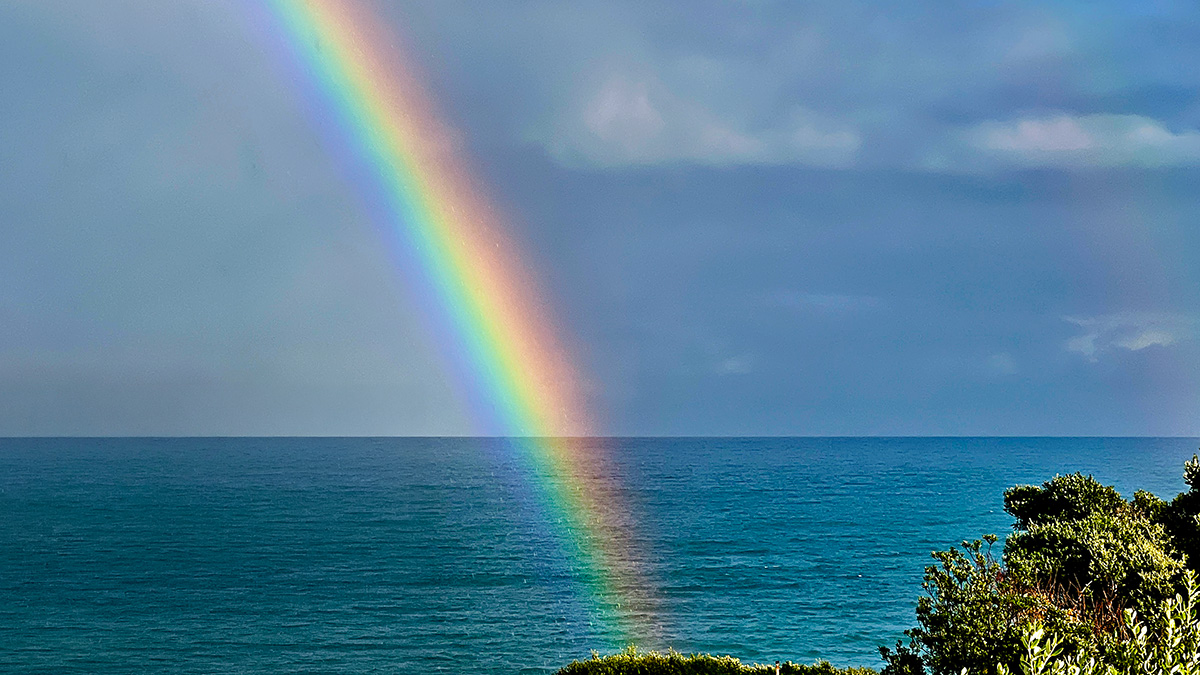
I read the flood story as the ancient writer’s attempt to do just that. In response to the sacrifice of Noah, and by extension those of other pious individuals, the Lord hangs his bow, a symbol of violent warfare, in the clouds to be used no more.
As such, the sign of the rainbow reinforces the promise of a divinely sustained order, that will never again be shaken. The God who once vented his murderous rage against his own creation will never do so again.

- Dr Simon Skidmore is a Brisbane-based biblical scholar and educator. He is the creator of The Mimetic Exegete podcast, which applies mimetic theory to biblical texts, offering unique insights and practical applications. His recent book, Capital Punishment in the Pentateuch, explores ritual killing through René Girard’s mimetic theory.