
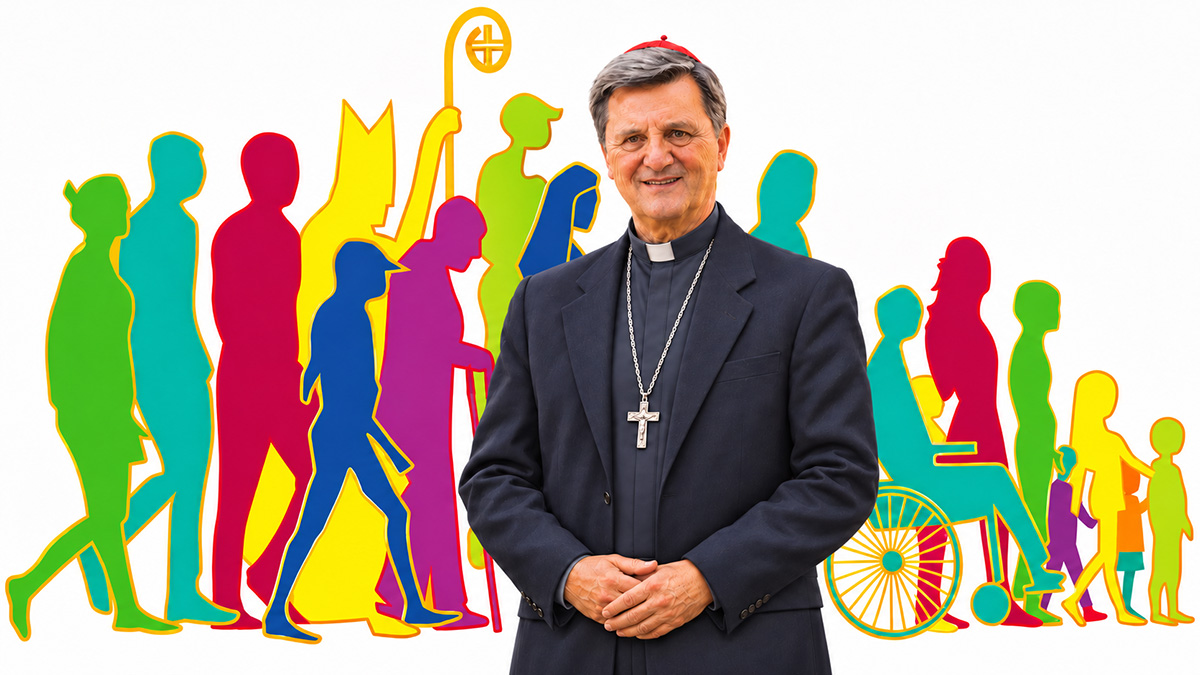
Cardinal Mario Grech, Secretary General of the Synod of Bishops, is not only a dedicated proponent of implementing synodality throughout the global church but is also building a welcome reputation for accessibility.
This may make him an attractive ally for anyone seeking to make their voice heard within the church, especially those frustrated by clogged official lines of communication.
Seeking his help to spur implementation at the local church level, seven member groups of the international church renewal movement wrote to the Cardinal in late October, welcoming the General Secretariat’s recent products on synodality.
These groups included We Are Church International, Root & Branch, Council of Australasian Catholics, Spirit Unbounded, Catholic Church Reform International, International Church Reform Network, and Association of Catholic Priests.
A cry for intervention
The letter offered assistance with his secretariat’s mission and called for the kind of intervention only a high-ranking Vatican official such as Grech can execute.
The key message was that the General Secretariat needs to issue ‘strong directions’ to ensure that synodality truly reflects the intentions of Pope Leo and the Synod of Bishops and is ‘not reduced to a charade with autocratic episcopal decision-making uninformed by the sensus fidei fidelium.’
The letter further warned that, based on experience with groups around the world, ‘many of the proposed mandatory pastoral councils might in practice be merely symbolic, with bishops controlling membership, meetings, and advice…’.
Parallel to the letter, the groups issued a media release pointedly titled ‘Catholics Reject Synodal Charades’, and shortly afterwards this generated a hoped-for report in the British church magazine The Tablet, under the headline “Bishops engage in ‘synodal charades’, reform groups warn the Vatican”.
Such wider publicity is essential to making reform voices heard amid the cacophony of church communication.
Calls for inclusion
The media release called on Cardinal Grech to ‘ensure’ that all elements of synodality include all the lay faithful in spirit and practice, and specifically requested that ‘canons excluding women from leadership and ministry be repealed’.
Language like ‘ensure’ is especially challenging.
Signs of hope
One can only hope now that this intervention bears fruit. Some hopeful signs appear in an otherwise barren environment.
No one, however, underestimates the enormity of implementing synodality within the global church.
Two major tasks
Grech and his secretariat face two major tasks: navigating the dynamics of the Vatican bureaucracy and inspiring, on behalf of Pope Leo, international momentum. Both tasks involve ‘resistances’.
The first may prove easier, despite the Roman Curia’s enduring reputation for fighting to preserve the hierarchical status quo.
The second must overcome what Grech has described, in other recent correspondence to a local Australian renewal group, as the different ‘ways’ and ‘rhythms’ in which different local churches experience the process of synodality.
Diocesan practice will vary for legitimate reasons, but local conditions can also be used just as an excuse for inaction or for a charade.
Each diocese, again in Grech’s words, is a ‘laboratory’ for synodality. Every Catholic has a stake in the outcomes from these laboratories.
- John Warhurst is an Emeritus Professor of Political Science at the Australian National University in Canberra and an executive member of one of these international renewal groups, the Council of Australasian Catholics.