
Anyone who reads my columns knows I am not a patient person. If I see a problem, I want it fixed now.
For global warming, we must switch to green energy. Government deficits? Increase taxes on the rich.
A bad translation of the liturgy? Use the 1998 translation by the International Commission on English in the Liturgy.
A shortage of priests? Allow married men to be ordained.
These problems and their solutions are so clear to me that I can’t understand why things can’t change immediately.
The patience of God
God, and his servant Pope Leo XIV, on the other hand, are exemplars of patience.
Jesus taught us about the patience of God in the Parable of the Weeds Among the Wheat (Mt. 13:24-30).
According to the parable, a man sowed good seed, but an enemy came at night and sowed weeds. When both grow in his field, his workers want to pull up the weeds as soon as they appear.
“No,” says the householder, “if you pull up the weeds, you might uproot the wheat along with them. Let them grow together until harvest.”
At harvest time, he tells the harvesters, “First collect the weeds and tie them in bundles for burning; but gather the wheat into my barn.”
Even though I know chemical weedkillers are bad, I would be sorely tempted to spray the weeds as soon as I saw them. But God’s ways are patient.
Pope Leo projects this kind of divine patience in leading the Catholic Church. He appears in no hurry to impose his will.
There have been no mass firings in the Roman Curia in over a year as pope. He has done nothing about the old Latin Mass.
He continues on the slow path of synodality even in the face of impatience from liberals and fear from conservatives.
A week in Rome
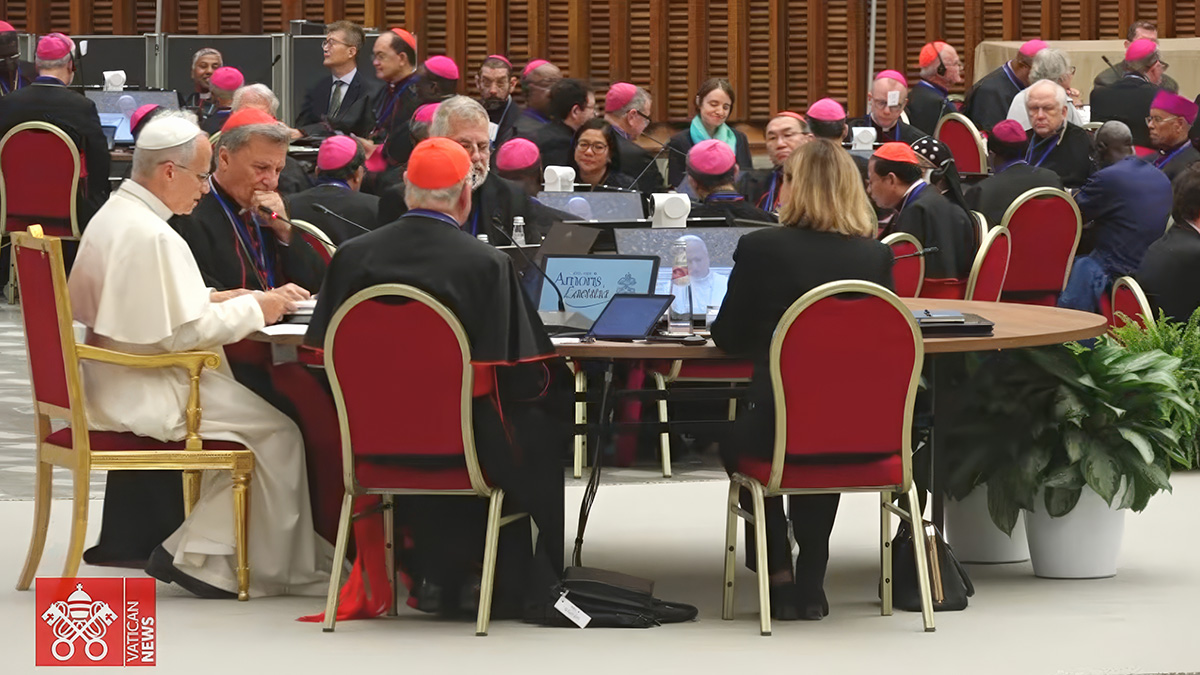
We have seen this patience especially this past week, in his Rome gathering of the presidents of episcopal conferences to discuss Pope Francis’ 2016 document “Amoris Laetitia” (“The Joy of Love”).
At first glance, the meeting seemed to have been constructed to accomplish nothing. It is only a week, which is too short a time to deal with a document with more than 50,000 words.
Leo made clear that the purpose of the meeting was not to revise “Amoris Laetitia,” Francis’ teaching document on marriage and family.
Rather, it was an opportunity for the participants to share their experiences in implementing it in their countries.
Leo understands that sharing stories and experiences is more impactful than theological and canonical lectures.
And like Francis, Leo understands the synodal process is more important than any document that comes out of the event.
Lessons from past synods
The first synod on the family in 1980, under John Paul II, was a mind-numbing event where curial cardinals told the bishops what topics could not be discussed, and the bishops showed their loyalty by quoting the pope to himself.
The lay observers were handpicked to tell the bishops how much they loved practicing natural family planning. American bishops were attacked for giving out too many annulments.
The synods in 2014 and 2015, under Pope Francis, were much more open. He asked the bishops to express their views boldly even if they disagreed with him.
Boy, did they.
By then, divorce had become more common around the world. Unlike in 1980, the conservatives were now promoting annulments as a solution for divorced and remarried Catholics.
But even well-staffed diocesan tribunals in countries like the U.S. could not keep up with the numbers of divorced and remarried Catholics.
A simpler and more pastoral approach was needed that would allow such Catholics to receive Communion, but conservatives denounced this.
Real threats to families
Pope Francis was angered by the single-minded focus on divorce among the media, which was mostly Western.
In most of the world, the greatest threats to the family were not divorce, but wars, political unrest, droughts, famines, globalization, unemployment and forced migration. They still are.
Francis wanted programs that would help families, not simply deal with them after they had fallen apart.
Pope Leo, with his pastoral experience in both North and South America, as well as with his extensive travels, knows well the threats families face.
Just as he listened during his travels across the globe as head of the Augustinians, he wants the bishops to listen and learn from each other.
The meeting in Rome will be a great experience for the participants, just as the synods have been, but it will not produce much, especially with the pope now in the hospital and undergoing surgery.
Whether this experience will bear fruit in dioceses around the world will depend on whether the episcopal conference presidents can replicate that experience at home with other bishops, priests and people.
They, like the householder’s servants, must plant the seeds and be patient with the weeds.

- Thomas Reese SJ is a senior analyst at Religion News Service, and a former columnist at National Catholic Reporter, and a former editor-in-chief of the weekly Catholic magazine America.
- First published in RNS. Republished with permission.