
The latest incident in relations between the Vatican and the USA stemmed from the stated intention of the Secretary of Defense (or “of War,” as he wishes to be called), Pete Hegseth, to livestream the execution of Nidal Hasan, the gunman who killed 13 people at the Fort Hood military base in 2009.
The Vatican Secretary of State, Cardinal Pietro Parolin, and Pope Leo XIV issued an unambiguous response against this attempt to reduce citizens to voyeurs and justice to vengeance.
One thing that somehow missed the news cycle is the widening gap between the Vatican’s worldview and that of the Trump administration, which emerged in the last month after Pope Leo’s speech in Metz (Sept. 28) – a remarkable speech about and to Europe.
When faith becomes a flag,
the gospel becomes a weapon.
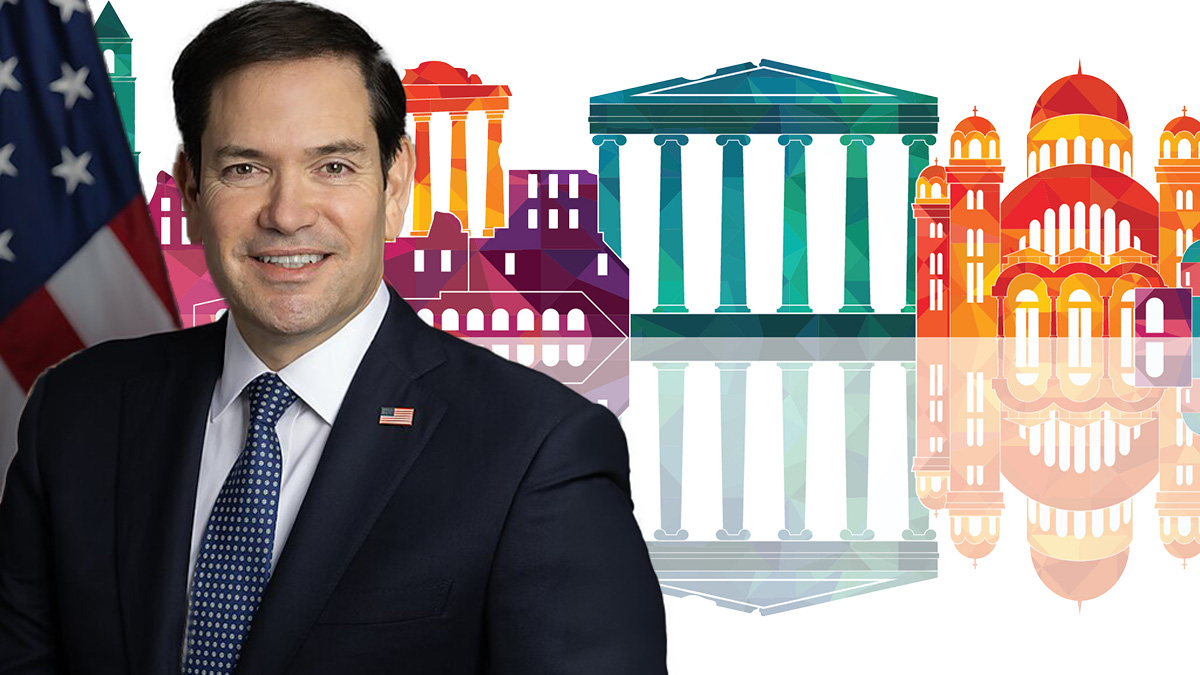
One of the most important documents for understanding what has changed in the American view of the world, and for showing that it is not going to disappear with the end of Trumpism, is US Secretary of State Marco Rubio’s speech in Athens on Oct. 7.
Delivered against the backdrop of the Parthenon, this carefully scripted speech by Rubio, a Catholic, outlines the civilizational narrative of the new nationalist right in America.
There is a specific view of world history that would merit a longer analysis.
What is relevant here is the attempt to absorb Christianity into the West – the Western world, mind, civilization, and moral imagination – under an “America First” plan.
Rubio’s idiosyncratic world map
For Rubio, it is Greek culture that started the partition of the world:
“It paved the way for the gospel of Jesus Christ to find fertile soil in Europe and flourish into the empire of Christendom. It was the foundation of the riches of Christian theology – of Augustine and Aquinas and the whole tradition of natural law.
It gave birth to a civilization marked not just by a common culture, it was marked by a common anthropology – a common view of man and his place in the universe.
Its descendants would share not just the idea of a natural order, but a distinctive understanding of virtue; of destiny and fate; of truth, goodness, and beauty; of a code that dictates how men ought to live; of objective standards and ideals to strive towards.”
Even more striking is the direct line drawn between Athens and the American Revolution.
Greece gave the qualities “that would shape the Western moral imagination.
From the Christian martyr who refused to betray his faith to the patriot who gave his life for his country; from Saint Thomas More to the Battle of the Alamo, running through the immortal closing words of the Declaration of Independence of the United States, which says, ‘We mutually pledge to each other our Lives, our Fortunes and our sacred Honor.’
It is from the Greeks that the West inherited its sense of duty – an unbreakable loyalty to one’s code, one’s cause, one’s country.”
According to Rubio, there is an unbreakable bond between Christianity and Western civilization:
“A civilization that we must fight to defend today with the same passion as our forefathers did. The men who built the Parthenon were succeeded by the architects of European Christendom, who raised the cathedrals of Milan, Cologne, and Florence.
The quest to perfect the human form that moved the ancient Greek sculptors found a new expression in Michelangelo. The Greek philosophers’ search for the structure of the universe was inherited by Copernicus, and then Galileo, then Kepler, and in Newton.”
Rubio draws a very idiosyncratic world map that connects Athens, Rome, London, and the USA:
“The greatest Americans of every generation have carried the unmistakable features of their forefathers – born in Athens, formed by Rome, baptized in Christendom, hardened in the furnace of medieval Europe, endowed with the English genius for liberty, and then carried across the Atlantic to be reborn on the shores of a new world.”
Missing from the map
From a historical, theological, and political point of view, it is remarkable that Jerusalem, Judaism, and Israel were never mentioned in Rubio’s speech.
More predictable is the absence of any mention of other Christians – from the Eastern European, Arab, and Asian traditions, from Africa and Latin America – in a world in which Christianity today is increasingly made up of believers from Africa, Asia, and Latin America.
Christianity as a tool
In Rubio’s speech delivered in Athens, Europe appears only as a point of passage toward the full embodiment of Christianity, as a civilization, in the United States.
The differences with Pope Leo XIV’s speech in Metz are stark.
In one of the most important speeches by a Catholic leader on Europe in recent times, Leo XIV offered a more nuanced view of the relationship between Christianity and civilizations:
“Europe gradually developed a sense of its own identity over the course of the historical periods of Hellenistic civilization, the Roman Empire, and the spread of Christianity, integrating, over time, new cultures, including the Germanic and Slavic cultures, thereby expanding to encompass ever larger regions. […]
Indeed, European civilization is also the fruit of centuries-long encounters, even though these have not always been easy.
We need only think of the presence of Arab culture in the Iberian Peninsula, or of the expansion of the ‘old continent’ into the ‘new world,’ which gave rise – at times painfully – to new integrations on the American continent.”
The most strategic move in Rubio’s speech was the attempt to absorb Christianity into the USA’s anti-Iranian politics, creating a contrast that dates back to the Greco-Persian Wars twenty-five centuries ago.
But the Vatican knows all too well that in early 2026, Trump’s United States collaborated with Israel in assassinating Ayatollah Ali Khamenei, who was also the leader of a religious tradition with which the Vatican maintains formal interfaith relations (not to mention that the Vatican and Iran have had diplomatic relations since 1954 – thirty years longer than the Vatican and the United States).
Israel guided the attack on a country, Iran, which is in the hands of a ruthless, oppressive regime but also represents a unicum east of the Suez since it was never a Western colony.
For almost a millennium, Persian was the lingua franca of Asia; Persian culture expressed nationalism well before the 1979 Khomeini Revolution, which has maintained a profound sense of historical continuity, transcending numerous political regimes; Persian civilization was also once an ecumene.
One should keep in mind the dictum attributed to the German historian Julius Beloch (1854–1929), “Greek history is a special case of Persian history.”
A widening Atlantic
Rubio’s call to arms to defend Western civilization and absorb Christianity into this civilizational narrative deepens the rift with both Europe and the Vatican, opened by his previous speech in Munich in February 2026 and vice president JD Vance’s speech in Munich in February 2025.
This worldview will not disappear with the end of the Trump era.
Paradoxically, it is during the pontificate of the first pope from the USA that the Atlantic has widened and that the Vatican is trying to save Christianity from becoming – once again – a tool in the hands of empire.
- Dr Massimo Faggioli is a professor of historical theology at Villanova University, an Augustinian Catholic university in the Philadelphia area. A specialist in modern church history, he focuses his research and commentary on global Catholicism, synodality, and the papacy.