
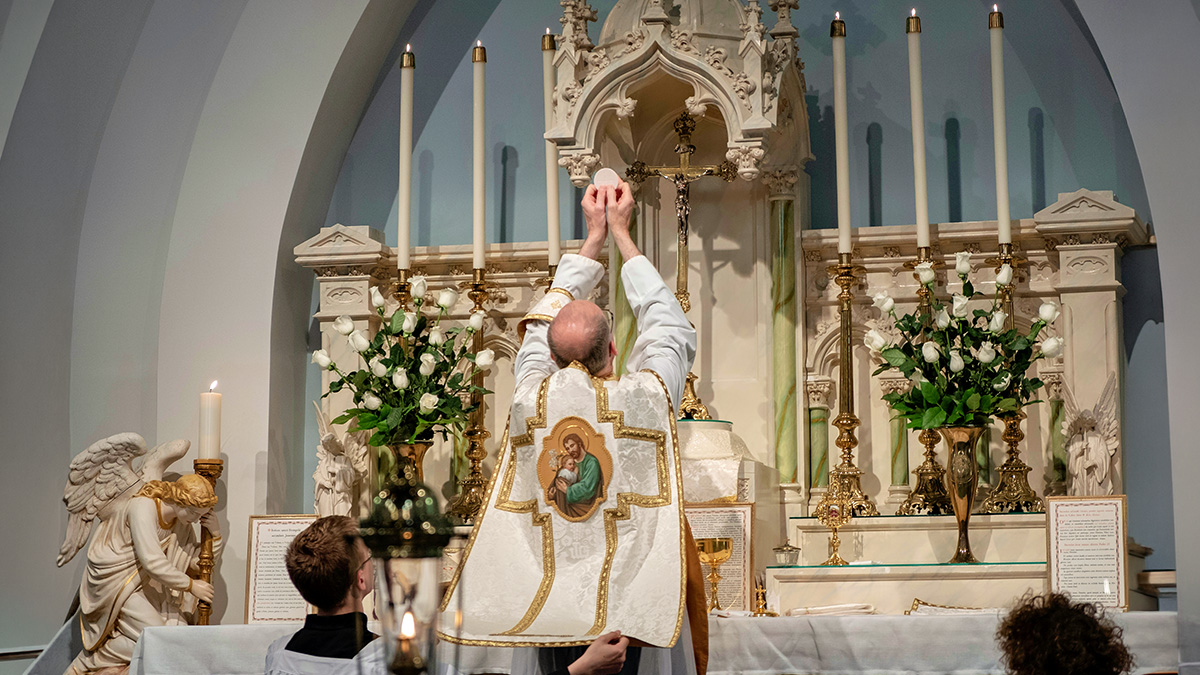
Jesus spent his life in the Roman province of Judaea, where four languages were in use: Latin, Koine Greek, Aramaic, and Hebrew.
Latin was the official language of Rome used by politicians, administrators and the military; Koine Greek was used in Judaea as the main language for administration and commerce among different cultures; Aramaic was the native language of Judaea, and Hebrew was the sacred language used for religious texts.
Of these languages, Koine Greek was the most commonly used in Judaea for administrative matters, and it is likely that Pontius Pilate spoke Greek and that Jesus also understood it.
Latin replaces Greek
In the early church, the Eucharist was celebrated in hidden places such as houses and catacombs.
The languages of the liturgy in both East and West were Greek, Aramaic, and Latin, with Greek prevailing even in Rome and Latin the least used.
However, in the late second century, Pope Victor I introduced Latin into the official Western liturgy while, in the East, Greek continued to be the main liturgical language.
From then onwards, in the West, Latin began to replace Greek as the primary language for the Roman liturgy and by the late fourth century, Greek had faded from common use.
Pope Damasus I then commissioned the Latin Vulgate version of the bible and the transition of the Roman Mass to Latin.
Latin becomes a barrier
This represented a significant change in the liturgical language of the Church because the average Roman Christian would not have understood the Latin Mass due to its increasingly complex and stylised nature.
The Latin Mass began to depart from being in the vernacular (Vulgar Latin), which would have been understood by the congregation, to becoming a ‘sacred language’ that used a stylised form of speech to express complex theological ideas.
In fact, the Latin Mass became the prerogative of clerics and intellectuals after Latin ceased to be a native spoken language in different areas (around 600-750 AD).
From then onwards, the Latin Mass became increasingly remote from the common people.
The Eastern Church’s path
While the Latin Mass became distant from Western congregations, this was not true of the Mass in the East (known as the Divine Liturgy).
The Divine Liturgy maintained its core structure while adapting to cultural and linguistic contexts. It was translated into Arabic in the eighth century and into Slavonic in 866 AD.
Therefore, the Eastern Church adapted its liturgy to diverse communities while the Western Church removed it from the common people.
This issue was one of many that led to the East-West Schism of 1054.
Vatican II’s new liturgy
The Latin Mass continued until 1969, when Pope Paul VI promulgated the Novus Ordo liturgy.
This was the Vatican II form of the Roman Rite, designed to foster greater understanding of the liturgy among the laity and more active participation as a result.
The message of the Gospel is Jesus’s message for all people of all nations. It is not just a message for the select intellectual few.

- Debra Maria Flint is a Catholic writer whose books include ‘No Place for a Woman’ and ‘The Sins of Mandatory Celibacy’ (co-authored with Paul Murphy Sanderson).