
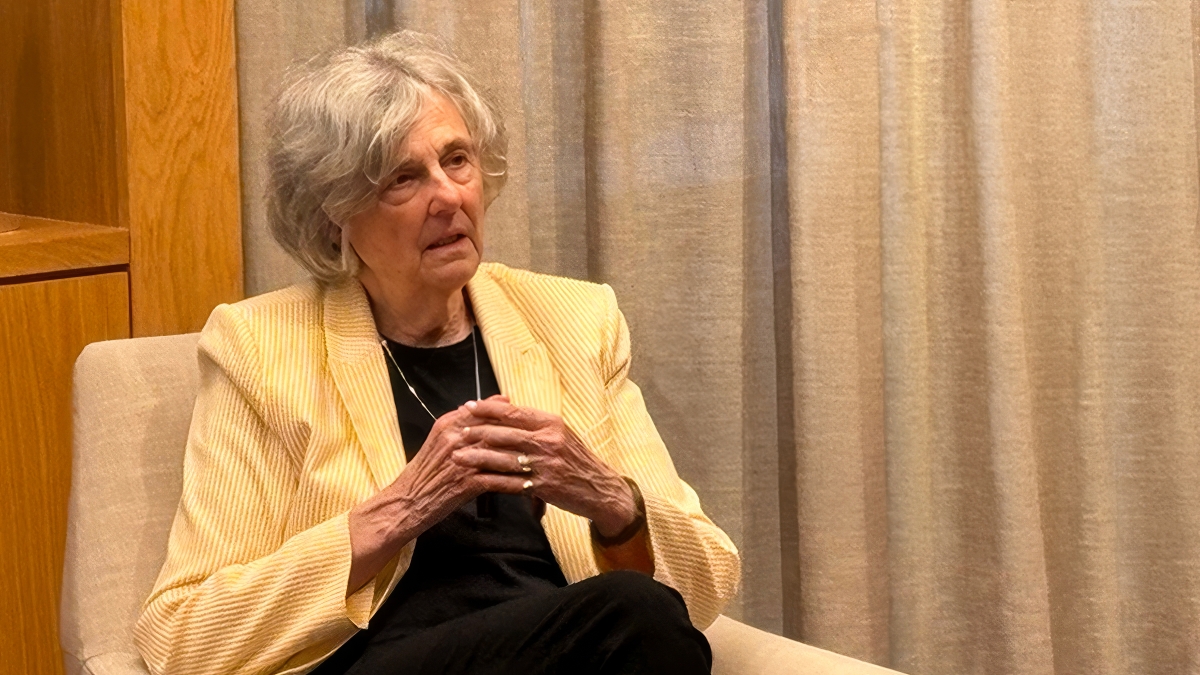
Phyllis Zagano’s investment in the question of women deacons reaches back to the 1970s, when a papal nuncio, hearing she was studying “to be a deacon,” told her simply, “Don’t quit.”
Decades later, she hasn’t.
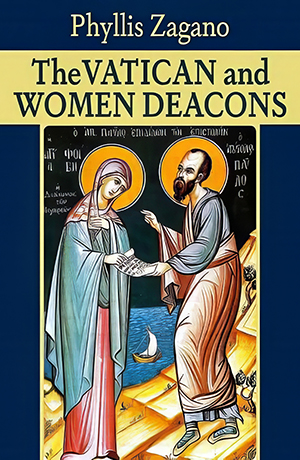
In “The Vatican and Women Deacons,” Zagano presents the fruit of a five-year archival journey across Europe: through monastic collections in northern Italy, archives in Paris, London and Spain, and eventually previously inaccessible Vatican material.
The resulting portrait is also a history of the Vatican itself: documents drafted and shelved, commissions formed and dissolved, questions deferred rather than resolved.
The deeper issue, Zagano argues, may no longer be whether women once served as sacramentally ordained deacons, but whether the church is willing to reconsider what it has already found.
Beyond the history
NCR: Your book appears to suggest that the question is no longer “Did women deacons exist?” but “Why has the church had such difficulty deciding what their existence means?” Have we moved from a historical debate to a debate about institutional self-understanding?
I think it’s necessary to understand that history is not dispositive.
You cannot argue that every woman deacon was ordained sacramentally, but neither can you argue that no woman deacon was ordained sacramentally — and that will never be resolved.
If you have two academics, you’ll have four opinions. It’s important to understand that in history, we know bishops used the same liturgy to ordain men and women as deacons.
A circular argument
Speaking of history, exactly on this point: when precisely did you realize that accumulating evidence was not actually moving the whole theological conversation and debate?
The Vatican was interested in the history of women deacons, but negatively — like, “Women only baptized nude women and we don’t do that anymore.” That’s what you would hear in a seminary.
A seminary professor in Philadelphia told me years ago that ordaining a woman was like ordaining a lamppost or a cat. That to me is the nexus of the problem.
I think the argument keeps getting pushed back to history, because history is always circular. You can never make a determination based on history — and that’s not necessary.
We don’t need to recover what women did in the past. We need to see what women can do today. How is the diaconate lived today? That is the question.
How can women perform it? The question is not whether women can be ordained. The question is whether women should be ordained. I think bishops would be lucky if they get women to work for them at this point.
Inside the commissions
Do you think that, with all this focus on synodality over the past three years, the era of secrecy and unpublished work on the issue of women deacons might come to an end?
In terms of preparing documents, no — because documents go through several drafts, and you wouldn’t want anything to come out in a draft that then has to be changed if it’s coming from the Vatican.
It’s not so much secrecy, but lack of transparency. It’s also a problem of reciprocity.
The problem is that the decisions are made predominantly by men, so we only have the male version of the world. That was brought out in the synod: you can’t have synodality unless you understand the reciprocity between genders. So that’s where the important movement will come.
I think the problems of transparency are deeper not so much in the Vatican, but in dioceses relative to money.
We don’t know who does what with what money many times in diocesan structures, and those kinds of decisions have great impact on people — because they have put their lives and personal funds into their parishes and diocesan structures.
When talking about decision-making, I think it goes beyond the documents about women in the diaconate. I think it’s all part of a puzzle.
The secrecy will continue because it’s “their church.” It is the church of the hierarchy, and that is really the problem of clericalism: “We’re clerics and you are not.”
The role of misogyny
You spoke very directly about misogyny. Some people might argue that the issue is theology rather than sexism. Why have you come to see misogyny instead as the central issue rather than a peripheral one? You suggested that many arguments about women deacons ultimately rest on assumptions about women’s bodies and women’s relationships that are not sacred compared to men’s. How much of this debate do you think is anthropological rather than theological?
I think the whole discussion is historical, anthropological and theological. You can’t resolve the discussion without looking at all the pieces.
If, in terms of anthropology, we don’t have a better understanding of gendered bodies, and we don’t have a denial of the taboos about women’s bodies, we won’t get any place.
I think that Pope Francis’ determination that women can be installed as lectors and acolytes, as well as other laypersons, is very important — because then women will be on the other side of the altar rail. They would be near the sacred.
The original complaint about women deacons by Pope Gelasius I in the fifth century — that women were at the altar — and the ancient blood taboos about women will just go away.
Matthew Blastares in the 14th century said yes, women were ordained as deacons, but on account of their menses they were restricted from the altar.
In certain countries, altar linens had to be rinsed first by a man, then handed over the altar rail to the woman to be laundered and ironed. Women could never touch a sacred vessel.
It depends on culture, what culture you are in. The church is not a monolith.
The best example I think we have is the Greek church, because they don’t have these hang-ups about marriage, married priests or about women.
There are women deacons historically in Orthodoxy, and even today in Africa a woman was sacramentally ordained a deacon with the permission of the Greek Orthodox Patriarch of Alexandria and All Africa.
What the church loses
What do you think the church is losing by not allowing women deacons today?
If by the church you mean the people of God, you have half of the people of God not represented and officially deemed unable to represent Christ. That’s a huge problem.
The church is losing half of the human view of life — which would include half of the way to view the Gospel, half of the way to understand the needs of the people of God.
It’s not a question of power. It’s more a question of a perception that the Catholic Church is saying to the world that women are not important by saying women cannot be ordained as deacons.
In medieval Europe, the question was whether women are the same species as men. That’s really the bottom line. When God is male, the male becomes God.
The argument is that Christ does not live in the resurrection in women. To say that is damning.
Not only Christians, but everyone in the world, can point to the Catholic Church to say women are second class and women don’t deserve the same respect as men.
Advice for Pope Leo
You worked with Pope Francis on the women deacons issue. If Pope Leo XIV called you tomorrow and asked for a single sentence of advice — not a commission report — what would you say?
I would suggest that he tell the church there is no doctrine forbidding the ordination of women as deacons — that if national bishops’ assemblies feel this is good for their areas to request the permission, knowing that individual bishops can do what they wish, that is what I would ask him to consider.
Not to force any bishop to ordain anyone, but rather to affirm that this is simply an abandoned practice — and also to accept the implicit request of the Amazon synod to ordain women deacons, as well as the request of the team leader of the European synod team for women in leadership and ordained women deacons.
The pope’s response to the European team leader was that it is a problem of culture. The problem of culture is solved by his simply saying, “If it’s acceptable in your culture, then you ordain women as deacons.”
- Interview by Camillo Barone, NCR staff reporter.
- First published in National Catholic Reporter. Reprinted by permission of NCR Publishing Company www.NCROnline.org”
Buy the book
For shipping inside the US click this link.
For shipping outside the US, click this link, then place your order via the international distributor nearest you.
If you have trouble contacting the distributor closest to you, please send an e-mail to orbisbooks@maryknoll.org and enter International Book Order in the email’s Subject area.