
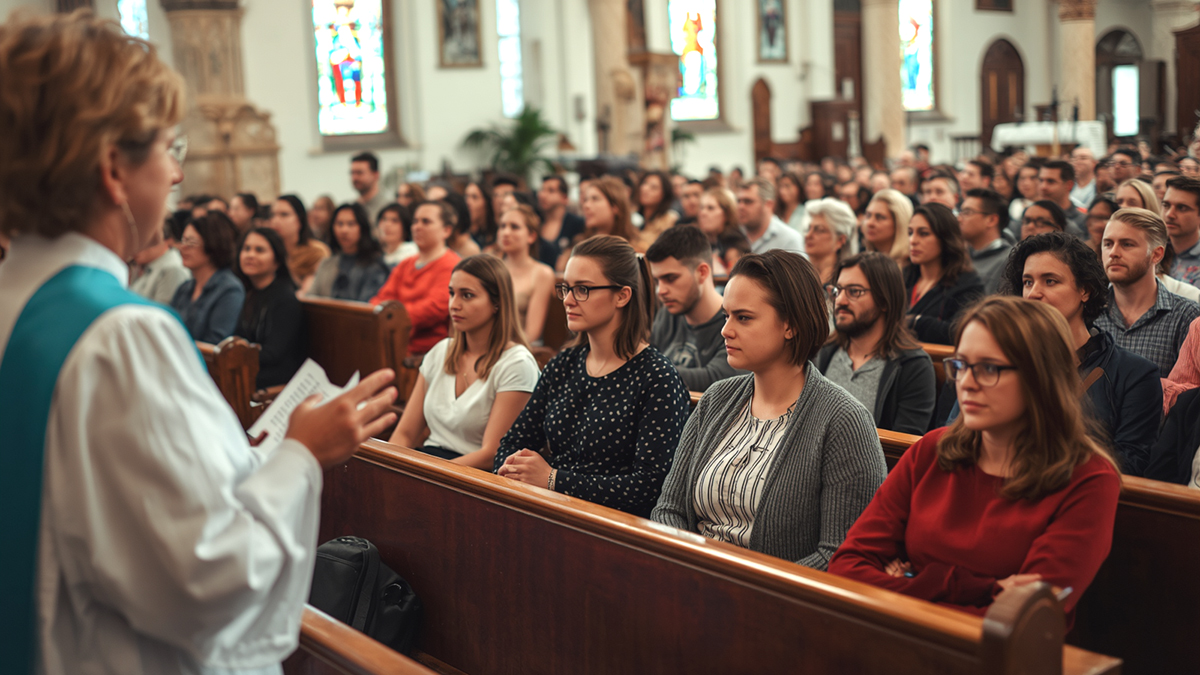
There is an understandable instinct in liturgy to explain.
When people are unfamiliar with the rites, when children are present, when a symbol is unusual, or when a community is being invited into something new, commentary can feel like the hospitable thing to do.
The Church does not ask people to participate with confusion. Yet there is a point at which explanation, even when well-intentioned, can begin to crowd out encounter.
Beyond explanation
Good liturgy must be intelligible, but it is not exhausted by explanation.
The Second Vatican Council’s call for full, conscious and active participation rightly assumes that the faithful are not spectators, but participants in the Church’s prayer.
Yet participation is not achieved by commentary alone. The liturgy works through symbol, gesture, silence, repetition and sacramental action. It does not merely communicate ideas about God; it draws the assembly into the mystery of Christ.
Instruction explains what something means. Mystagogy leads people more deeply into the mystery they have encountered.
Paragraph 1075 of the Catechism describes liturgical catechesis as proceeding “from the visible to the invisible, from the sign to the thing signified.” That movement is pivotal.
The visible sign carries meaning in a way that explanation alone cannot. It allows the mystery to be encountered through the senses, the body and the shared action of the assembly.
Symbol as doorway
A symbol is not a puzzle waiting for a caption, but rather a doorway into participation.
Water, oil, fire, bread, wine, silence, posture and procession do not simply stand for something else; within the liturgical action, they do something.
They engage the body, awaken memory, shape attention and invite response. When every symbol is immediately explained, the assembly may understand more, but perceive less.
The work of silence
Silence is a clear example. It is not empty space, nor merely a pause between words.
Silence protects the mystery from being reduced too quickly to speech.
It allows the word proclaimed, the prayer offered, or the sacramental action completed to echo within the assembly. If every silence is filled, the rite loses one of its own ways of speaking.
Formation, not commentary
This is not an argument against formation, clarity or good preparation. It is an argument for formation that respects the nature of liturgy.
Catechesis belongs around the liturgy: in preparation, preaching, parish formation, school learning, sacramental programs and mystagogical reflection afterwards.
But within the liturgy itself, the rite must also be trusted. Commentary can be useful at the threshold of prayer, but too much commentary from within the rite can place people at a distance from the very action they are meant to inhabit.
Mystery has sometimes been understood as that which remains when an explanation has failed, while in fact, it is the depth that remains after even the best explanation has done all it can.
Not everything holy needs to be explained because not everything holy is received as information. Some things are entered, enacted, contemplated and slowly understood.
The task of liturgical formation is to lead the faithful beyond commentary, deepening their capacity to perceive, through symbol, silence, gesture and prayer, the mystery of Christ made present in the liturgy.

- Clare Schwantes holds a PhD from the University of Queensland and a Master of Theological Studies with a focus on Liturgy, in addition to Bachelor’s degrees in Education and Psychology. She also has diplomas in Editing and Publishing and is a graduate of the Australian Institute of Company Directors. She is the Director of the Archdiocesan Liturgy Office in Brisbane, Australia and Chair of the National Liturgical Council in Australia.
- Clare is the author of From Page to Proclamation – Interpreting Scripture in the Context of Liturgy (2024).