
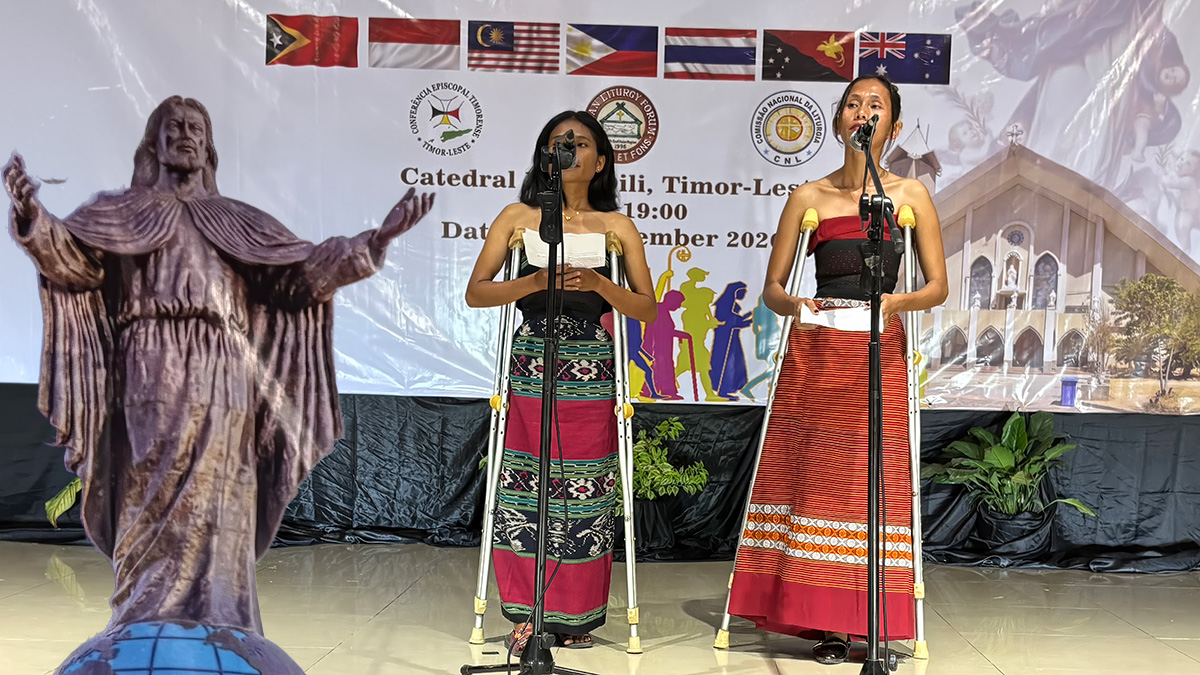
‘You are my friend you help me fly. Fly with tears, bent full of joy. Fly all the way to the land of God.’ (A poem written by two young Timor Leste women.)
Recently I spent a week in Timor Leste at the invitation of the Asian Liturgy Forum.
From the moment we arrived at their humble airport and were escorted to the VIP room, to the time we departed – from that same room, we were treated with exceptional hospitality, friendliness and deep respect.
A nation still healing
It has now been twenty-five years since Timor Leste, a largely Catholic country, defeated its occupiers, Indonesia. Prior to 1999, also for twenty-five years, the native peoples fought for their independence.
While the average age of the Timor Leste nation is 22 years, everyone has been affected in some way by the war: lost a parent, grandparent, friend, relation, or neighbor, many of whom continue to be ‘missing’.
Others have survived extreme torture that continues to affect not only themselves but their children.
Today Timor Leste is a country of extreme poverty with few resources and high unemployment.
Liturgy and synodality
The Liturgy Forum consisted of members from Indonesia, Malaysia, the Philippines and of course the hosts. Visitors came from the nations of Papua New Guinea and two of us from Australia.
For five days we were enriched by lectures and national reports, addressing the topic of liturgy and synodality.
Encounters that remain
It was the afternoon and evening field trips that have left a deep and lasting impression on me.
I learned that one of the local priests attending the Forum had been part of the 1999 massacre at Santa Cruz cemetery. At the time he was a seventeen-year-old seminarian.
I wondered what he felt as we were taken to museums and the Santa Cruz cemetery. Over the week, when the opportunity arose, he shared with me the details of the horror that unfolded on that day.
A poignant moment for all of us was a tearful apology from Lena, secretary of the Liturgy Forum, on behalf of her country, Indonesia, to the Prime Minister, Xanana Gusmão, with whom many of us were blessed to spend an hour-long meeting.
His graciousness and generosity reflected the great leader he continues to be.
We were also received by many different groups and church communities who not only provided lavish banquets but also showered us with many gifts.
Twenty one students, dressed formally in black uniforms, were charged with the task of protecting us and ‘keeping us safe.’
We were blessed by their constant attentiveness to our every need.
Looking for wings
One of our visits was to a home for young people living with disabilities.
The poem, entitled ‘I’m looking for my wings’ was recited by two beautiful young women. Each had the use of only one leg – ‘one wing’.
These women, and indeed all those we met, reflected the deep joy and peace that can only come from deep struggle, suffering and loss.
Their cry of hope will always stay with me: ‘I have one wing in you. You have one wing in me. You help me fly.’
- Carmel Pilcher RSJ, PhD is a Liturgy and Culture Consultant and Educator, Darug and Gundungura country.