
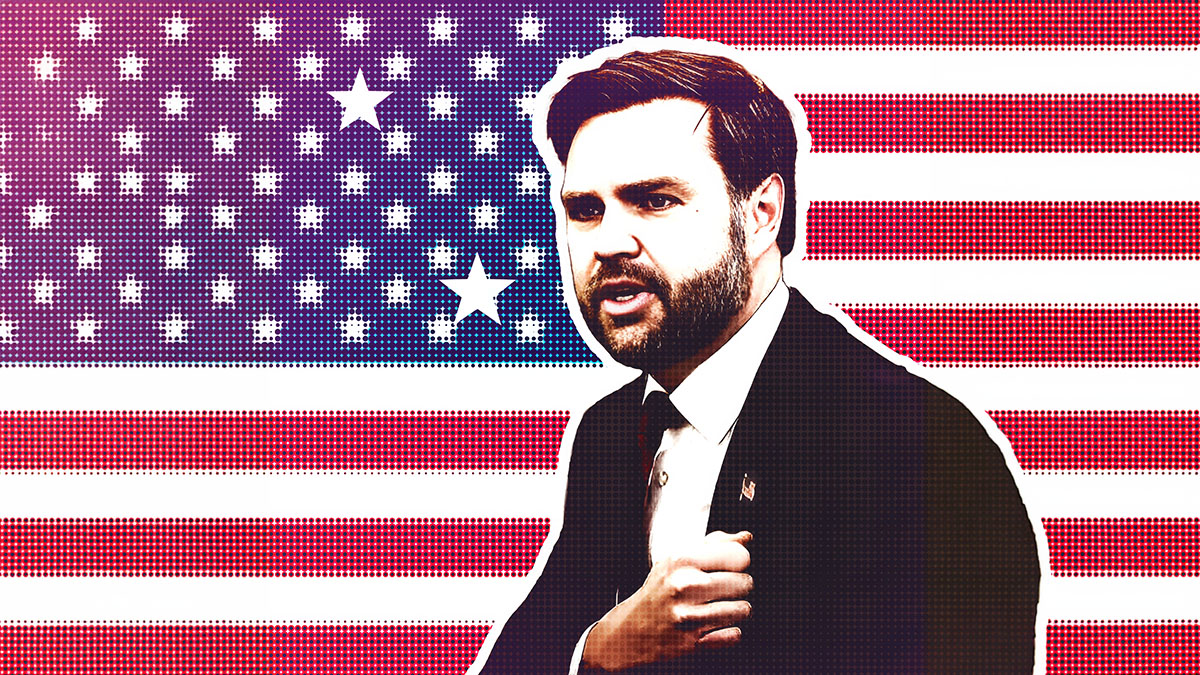
U.S. Vice President JD Vance’s Communion: Finding My Way Back to Faith topped the Publishers Weekly Best Seller list when it appeared in mid-June, just in time for summertime reading in United States.
The New York Times and Amazon continue to echo its popularity.
Before you consider reading this hard-cover memoir, think about who wrote it and what he might be saying.
The book has been touted as an exploration of Vance’s conversion to Catholicism, following his early Christian upbringing and many years of unbelief.
Yet there are three distinct stories in the book: 1) personal recollections of family; 2) political commentary; 3) religious discussion. The sides of this triangle do not connect.
Many hands on the manuscript
Vance has said that he started writing the book years ago as he converted and acknowledged the many hands that massaged the manuscript over the years—friends, speechwriters, aides, even his wife, Usha, to whom the book is dedicated.
A conversion in Ohio
Vance was guided to convert to Catholicism by Dominican Friars and baptized in Ohio in 2019 at the age of thirty-five by Father Henry Stephan, himself a 2011 graduate of Princeton University.
So far so good. No one can criticize Vance’s conversion or question his sincerity.
Even so, it is odd that the book cover features a photo of a Methodist church, and Vance quotes Scripture from the King James Bible.
Overall, Vance’s grasp of Catholicism seems tenuous at best.
Given his political essays interspersed throughout the book, combined with his later public statements, his conversion appears to be more to a sort of Republican Christian Nationalism than to Roman Catholicism.
A telling epiphany
Having said that, one small comment in the dead center of the book underpins his conversion to Christianity.
Recounting what he calls an epiphany, he lists his reasons for resisting conversion: frustration about saying prayers, cheap grace, church scandals, and a news cycle fixated on Terri Schiavo, a brain-dead Florida woman kept alive for seven years.
His list of complaints about Catholicism includes one of his wife’s major concerns as well: clerical sex abuse cases.
The Bonhoeffer connection
But the telling words in his epiphany recollection are “cheap grace,” if he means the theological concept developed by German Lutheran pastor Dietrich Bonhoeffer in his 1937 book “The Cost of Discipleship.”
Vance may have heard about “cheap grace” at Ohio State, where he earned his undergraduate degree, or during his law studies at Yale University.
Recognizing that grace and pardon are not available to anyone without true repentance and specific obedience to the teachings of Jesus Christ is an important point in conversion to any Christian church or denomination.
Clashes with church teaching
If Vance’s conversion to Catholicism included that recognition, and if (as he says) he truly embraces the Catholic Social Teaching of Pope Leo XIII, then the cognitive dissonance and internal contradictions in this book are more than jarring.
His political commentary sometimes collides with Catholic Social Teaching.
His televised suggestion in defense of President Trump’s criticism of Pope Leo XIV causes pause.
Of that, he said: “It would be best for the Vatican to stick to matters of morality, to stick to matters of what’s going on in the Catholic church and let the president of the United States stick to dictating American public policy.”
Misreading the Vatican
It might be well if this relatively new Catholic learns a little more about Catholicism before he criticizes the Vatican.
For example, he completely misunderstands how Vatican diplomats presented Catholic teaching to him during his Holy Week, 2025 trip.
They did not cite specifics about the ways the United States had displayed zero understanding, let alone adherence, to Catholic, even Christian principles in matters of immigration.
“Here I was, the most senior Catholic in the United States government, and the Vatican seemed unwilling to move its moral guidance past the point of trite platitudes,” Vance wrote.
As for Catholic practice, he presents an anecdote about one of his children’s antics in St. Peter’s Basilica on Good Friday: “Not wanting the world to see me laughing hysterically during a Mass mourning Christ’s passion…” (The Good Friday liturgy is not Mass.)
An eye on 2028
Vance’s book traces his personal philosophical return to Christianity, mixed with harsh political views and personal recollections, no doubt because he hopes to run for president in 2028.
While he may at times seem to be the adult in the room, knows he needs Trump’s endorsement.
So Catholic Social Teaching, apparently attractive as it is to him, cannot be uppermost in his agenda.
Overall, the book is disappointing in its thinness.
It is an okay weekend read and an important window into his character. But get it from the library.
Communion: Finding My Way Back to Faith
JD Vance
HarperCollins, 2026
288 pp.
$35.00 hardcomver; $16.99 Kindle
- Phyllis Zagano holds a research appointment at Hofstra University, Hempstead, NY, USA and is author most recently of The Vatican and Women Deacons (Orbis, 2026).