

Before I began the secular priest project, I didn’t think a great deal about God.
I yearned for practices that encouraged an outward focus – beyond me and mine and towards everyone else and the planet we share; and I knew religions specialised in these.
I would speak with Christians about their faith without reference to the entity, many insisted, on which it all pivots.
I still struggle with God as a noun that “exists” (or not), but the notion of divine love may be one of the most important human stories and it is largely missing from the secular world.
Finding God in connection
On the evening The Calling was launched, I was interviewed by Emile Donovan on RNZ Nights. The interview was at 9.25pm after the launch event and a day that had started for me at 5.10am. I was both hyped and exhausted.
Partway through the interview I said that if we imagine that God is in both of us, it’s like gravity and pulls us towards each other.
As I said this, I felt a profound connection to Emile (and hoped it wasn’t obvious!). By invoking the divine, it seemed, the divine had appeared.
Examples of divine love
Throughout my year investigating Christianity I came across many examples in which divine love created extraordinary capacity in people.
Martin Luther King’s courage in the face of death threats and his refusal to condemn those who – in today’s language – “benefited” from racial injustice, was attributed by him to the God he could tap into but never possess.
I saw it too in the Christian leaders I got to know well. They had the usual human uncertainty, disappointments and interpersonal struggles, but each had a certain openness – as if they had sufficient space between each cell to allow the breeze through.
I noticed them self-correct at times when they could have, but didn’t, reach for a story of blame.
Rohr on universal love
In The Universal Christ, the Franciscan priest Richard Rohr wrote:
“The essential function of religion is to radically connect us with everything. (Re-ligio = to re-ligament or reconnect.)”
He also wrote that
“Love, which might be called the attraction of all things toward all things, is a universal language and underlying energy that keeps showing itself despite our best efforts to resist it… Love allows and accommodates everything in human experience, both the good and the bad, and nothing else can really do this.”
A story we need
God and even love in the sense Rohr uses it above, are, to me stories we tell ourselves; but what beautiful, necessary stories. They function to uplift us and pull us towards each other.
By losing religion, we seculars have lost the story of divine love and, to paraphrase Rohr, nothing else can quite take its place.
Perhaps, over time, we will find ways to tell of it again, as creatures drawn to an imagined God.
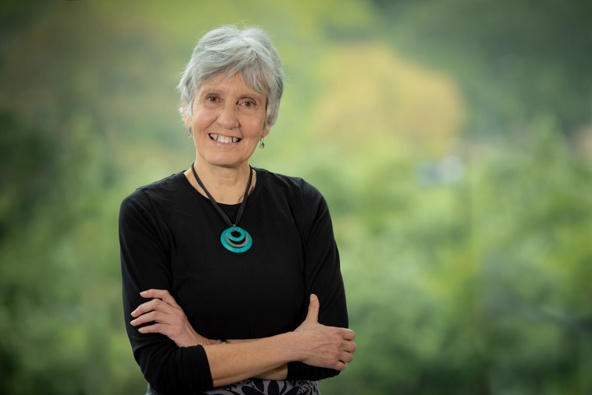
- Niki Harré is a psychology professor at the University of Auckland and atheist. In 2021 she spent a year as a self-appointed secular priest. The Calling: A year exploring what the secular world can learn from religion describes her experience. In this, the first of a three-part series, she discusses what the secular world has lost by turning away from institutional religion.