
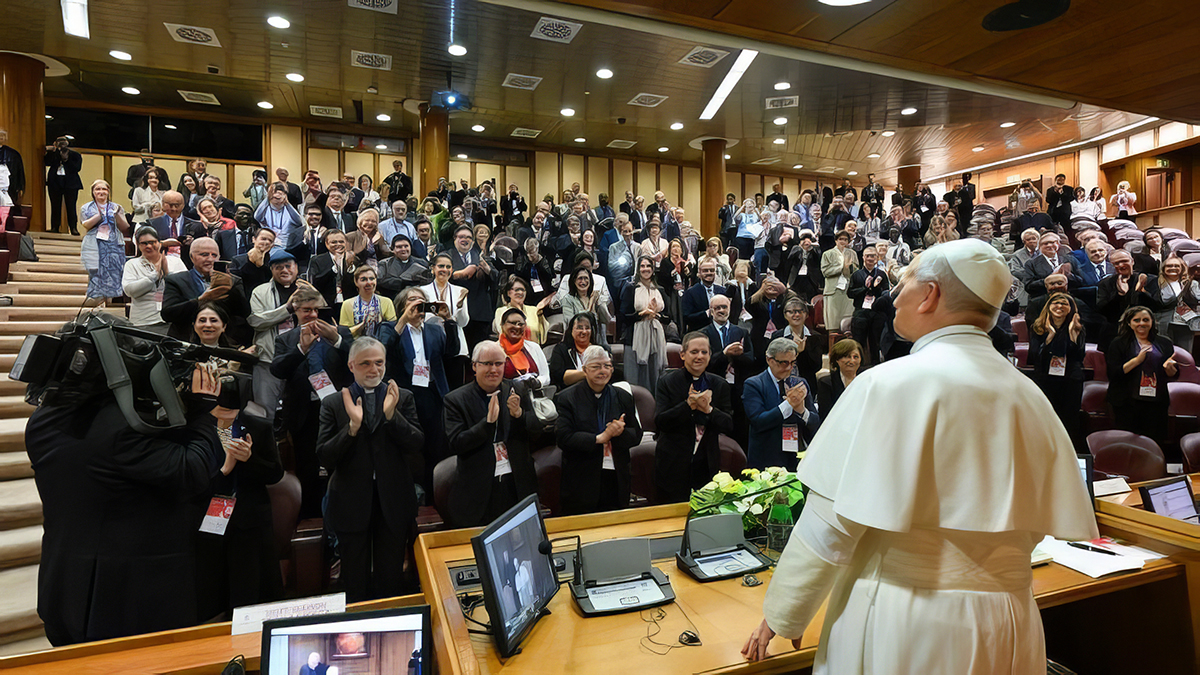
Two hundred lay leaders recently walked into the Vatican’s Synod Hall. They sat down. They listened. They shook the pope’s hand. Then they went home.
If that sequence sounds unremarkable, that’s precisely the problem.

The room remembers
Just two years earlier the same Synod Hall hosted round-table conversations during the Synod on Synodality.
That gathering made “listening” and “dialogue” load-bearing words in Catholic institutional life.
Bishops sat beside laypeople. The geometry of the room was the message; the room’s geometry was the theology — everyone was heard.
When lay leaders returned to that hall in May 2026, the round tables were gone. In their place: rows of chairs facing a podium. The architecture of authority had quietly reasserted itself.
Room layouts are never accidental at the Vatican. Every candle, every chair, every sightline is curated. When the furniture reverts, it tells you what the institution actually prioritises once the spotlight moves on.


Thirty-five years of déjà vu
What makes this sting is the time elapsed?
In 1991, Pope John Paul II addressed a nearly identical gathering of international Catholic leaders. Same format — papal speech, handshake line, no dialogue. That was frustrating then, but at least the Church hadn’t spent years publicly committing itself to mutual listening.
The Church of 2026 has. It ran a global synodal process. It published documents. It changed vocabulary. And then it seated 200 elected leaders in rows and gave them a lecture.
Irony at the lectern
Pope Leo’s speech itself praised “free elections” within lay organisations as “an expression of common discernment” allowing “everyone’s voice to be freely expressed.” He was right. Most of those present had been democratically elected by movements spanning every continent.
Yet the format offered them exactly zero opportunity to exercise that voice in the pope’s presence. They could listen to a speech about the value of being heard — but they could not, themselves, be heard.
This is not a criticism of the speech, which was reportedly excellent. It is a criticism of a structure that contradicts its own stated theology.
You do not honour discernment by staging a monologue.
Still time to pivot
These gatherings are organised by the Dicastery for Laity, Family and Life. Nothing prevents future editions from incorporating even a single session of structured dialogue — the very methodology the Synod refined and celebrated.
Pope Leo is one year into a pontificate with room to set new patterns. The test of synodality was never whether bishops could sit at round tables. It was whether the institution would extend that posture to everyone else.
The chairs are easy to rearrange. The question is whether anyone in Rome thinks they should be.
- Stefan Gigacz is an Australian researcher and writer with a special focus on the life and work of Joseph Cardijn, founder of the Young Christian Workers (YCW)