
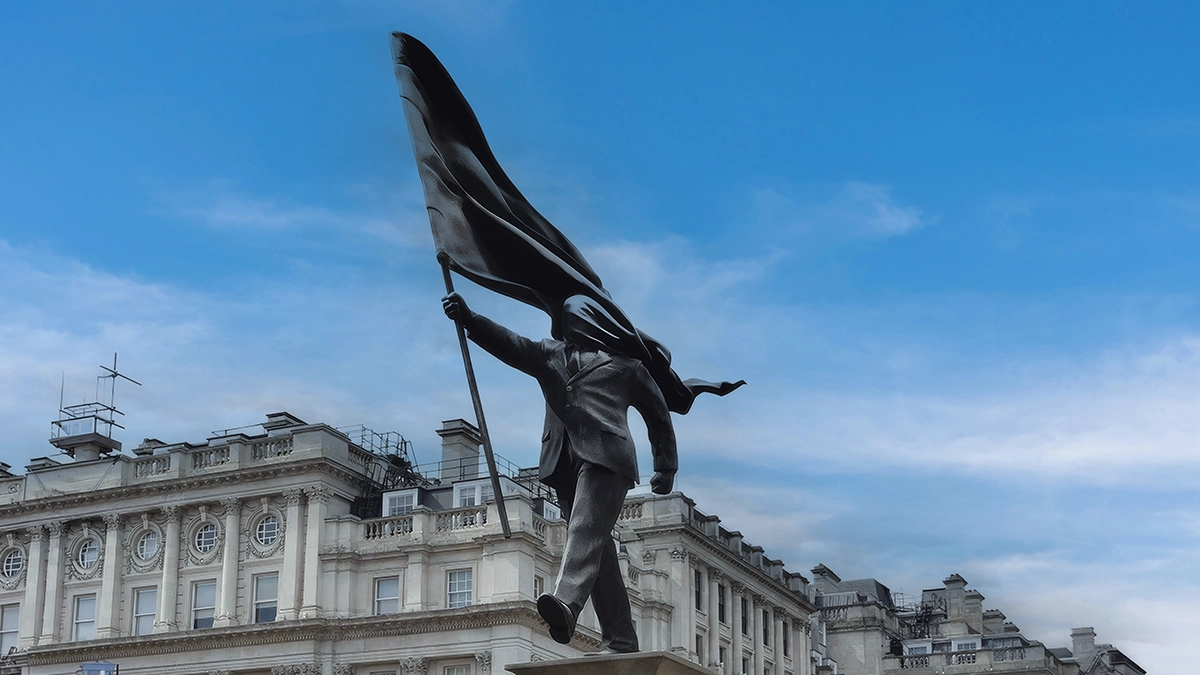
If a picture is worth 1,000 words, then a 3-D statue is worth that amount cubed: 1,000,000.
Here, however, is just 500 words on the statue that “appeared” in London in the early hours of Wednesday, 29 April.
The image seems banal — a man in a suit, almost unremarkable. But it does capture our moment with more precision and insight than all the editorials written this year.
We grasp its message in a moment. It is truly the trigger of a flash of insight.
Flags and folly
Over recent years there has been a massive upsurge in using flags. Politicians seem somehow naked without one behind them when interviewed.
Some need two flags — more assertive! Some need a whole backdrop of flags — all saying that the speaker is a person of power.
They stand before the flag. The flag is a symbol of how powerful they are. They are “big” because of the flag — they know who they represent!
Why not let their words, what they are uttering, be their message?
Flags can be great fun at a football match. But they can be tools of intimidation when they become the possession of a marching group intent on proclaiming identity and ownership of a country.
We have any number of bad memories: rallying ’round the flag, being called to the colours, dying for the flag!
Living a life that builds peace and justice in the world and fosters sisterhood and brotherhood between people seems too weak-kneed, too woke, too sissy, too silly — beside the harsh steps of those who confidently march with flags.
Nations and nationalism
Nationalism was a product of the nineteenth century. It was a soothing pseudo-religion that made people malleable to their rulers and so involved in “us” and “them” that enmity became a central theme in politics.
No need to talk about being peace-makers and all as sisters and brothers in the Lord when one could have the flag blessed and — with Gott mit uns on your belt-buckle — march off to war.
Nationalism is blinding. That flag just covers the eyes.
Flag-bedecked and as believing nationalists, our grandfathers marched off to war again and again. In the later 20th century we thought we were learning the lessons.
Saviour leaders
The confident leader — with all the attributes of the saviour — marches forward, blinded by their own rhetoric and irrational commitments, and steps into the void.
The followers are so focused on the saviour that they cannot see his blindness and, shouting slogans of support, march after him into the pit.
Who is represented in Banksy’s statue? Each of us could name someone.
But in fact it is a whole political caste: populists exciting irrationality and rejecting dialogue and peace-making.
I could rattle off a dozen names of leaders who play with this fire — and folly.
“If the blind lead the blind, both fall into the pit” (Matthew 15:14).

- Thomas O’Loughlin is a presbyter of the Catholic Diocese of Arundel and Brighton and professor emeritus of historical theology at the University of Nottingham (UK). His latest book is Discipleship and Society in the Early Churches.
- His latest book is “Shaping the Assembly: How Our Buildings form us in Worship”.