

In his first term in office, Trump delivered on his promise to reconstitute the Supreme Court in the hope that a newly constituted bench would strike down the 1973 abortion decision Roe v Wade.
The court did so in the Dobbs decision that was delivered in June 2022, early in the term of president Joe Biden, who decried the decision.
The decision was hailed as a great win by most of the US Catholic bishops, who had long campaigned on abortion, attracting many Catholics to the Republican Party.
Trump had a good relationship with New York cardinal Timothy Dolan, who had recited the first prayer at Trump’s inauguration in 2017.
Pope Francis was just as focused on migration issues as he was on abortion. He saw them both as life issues.
Francis was concerned that the US bishops were not doing enough to stand up to Trump, who was committed to building the wall at the US-Mexico border and deporting in great numbers people without visas.
Francis kept insisting on the need to build bridges, not walls.
Francis captain’s picks
While Trump was reconstituting the Supreme Court, Francis had already set about reconstituting the senior ranks of the US Catholic hierarchy.
He made three captain’s picks.
He appointed Blase Cupich as Archbishop of Chicago in 2014.
The next year he appointed Robert McElroy as bishop of San Diego, which included areas close to the Mexican border.
McElroy had two doctorates, including one in political science.
He had made a special study of the Jesuit John Courtney Murray who had been instrumental in the Second Vatican Council’s decree on religious liberty. Murray was the only American who had made a significant contribution to the work of that historic council.
In 2016, Francis appointed Cupich and Joseph Tobin as cardinals.
Then in 2022 he completed the trifecta, appointing McElroy as a cardinal.
Two weeks before Trump’s second inauguration, Francis appointed McElroy as archbishop of Washington DC.
The episcopal chess pieces were in place.
Just as Trump was resuming office as President in early 2025, Francis was in physical decline spending weeks in hospital with pneumonia.
Trump’s Vice-President, JD Vance, a Catholic convert, decided it was time to take on those Catholic clerics who were critical of the Trump migration policies.
Francis’ letter to bishops
Francis took the unprecedented step of writing and publishing a letter to the US bishops.
It was known that he sought the advice of one Robert Prevost, the American cardinal who was based in Rome having spent many years as a missionary in Peru.
Francis wrote:
“I have followed closely the major crisis that is taking place in the United States with the initiation of a program of mass deportations. The rightly formed conscience cannot fail to make a critical judgment and express its disagreement with any measure that tacitly or explicitly identifies the illegal status of some migrants with criminality.
“At the same time, one must recognise the right of a nation to defend itself and keep communities safe from those who have committed violent or serious crimes while in the country or prior to arrival.
“That said, the act of deporting people who in many cases have left their own land for reasons of extreme poverty, insecurity, exploitation, persecution or serious deterioration of the environment, damages the dignity of many men and women, and of entire families, and places them in a state of particular vulnerability and defencelessness.”
The trio of Cupich, Tobin and McElroy took up the pope’s plea for the church to advocate against the Trump policy.
Trump knew that most Catholics had voted for him and presumably had approved the policy in preference to that proposed by Biden and former vice-president Kamala Harris.
The battle lines were drawn between the Trump administration and Francis’s trio of cardinals.
On the death of Francis, Prevost was then elected as Pope, the first American to hold the position.
He took the name Leo XIV.
Dolan retired as archbishop of New York in December 2025.
This left the trio as the only three US cardinals running major dioceses.
Pope Leo’s peace agenda
On January 9, 2026, Pope Leo delivered his inaugural address to members of the diplomatic corps accredited to the Holy See.
He lamented “the weakness of multilateralism” at this time:
“A diplomacy that promotes dialogue and seeks consensus among all parties is being replaced by a diplomacy based on force, by either individuals or groups of allies.
“War is back in vogue and a zeal for war is spreading. The principle established after the second world war, which prohibited nations from using force to violate the borders of others, has been completely undermined.
“Peace is no longer sought as a gift and a desirable good in itself, or in the pursuit of ‘the establishment of the ordered universe willed by God, with a more perfect form of justice among men and women’.
“Instead, peace is sought through weapons as a condition for asserting one’s own dominion. This gravely threatens the rule of law, which is the foundation of all peaceful civil coexistence.”
A week later, the US trio of cardinals took the unprecedented step of publishing a joint statement entitled Charting a Moral Vision of American Foreign Policy.
They anchored their remarks on Leo’s paragraph just quoted. They lay down the gauntlet:
“As pastors and citizens, we embrace this vision for the establishment of a genuinely moral foreign policy for our nation. We seek to build a truly just and lasting peace, that peace which Jesus proclaimed in the Gospel. We renounce war as an instrument for narrow national interests and proclaim that military action must be seen only as a last resort in extreme situations, not a normal instrument of national policy.”
They concluded: “Our nation’s debate on the moral foundation for American policy is beset by polarisation, partisanship, and narrow economic and social interests. Pope Leo has given us the prism through which to raise it to a much higher level. We will preach, teach, and advocate in the coming months to make that higher level possible.”
A week after the US and Israeli attacks on Iran began, McElroy went public with his moral assessment of the war.
He meticulously set out the six conditions for a just war and concluded:
“At this present moment, the US decision to go to war against Iran fails to meet the just war threshold for a morally legitimate war in at least three requirements.”
When asked what advice he would offer to Catholics in his archdiocese of Washington DC, he spoke of the need for prayer and for pastoral support of all those involved in the conflict, then said:
“Finally, and most importantly, we must ensure that this war does not turn into a prolonged conflict, lurching from goal to goal and from strategy to strategy.
“One of the most important Catholic teachings on war and peace is that nations have the strict obligation to end a war as soon as possible. This is particularly true when the decision to go to war was not morally legitimate.
“There is a logic to war that presses onward, escalating in its dimensions and timeline. Our country has fallen victim to this logic of war in the recent past, especially in the Middle East. We must all work together to forbid this expansionism to lead us into an ongoing morass in Iran.”
From the beginning of this war, the trio have confined themselves to assessments of the war’s compliance with just war criteria.
The Easter confrontation
At Easter, Pope Leo announced that he would convene a vigil for peace on the Saturday evening after Easter.
Early on Easter morning, President Trump had begun his series of lamentable social media posts.
At the vigil for peace, Cardinal McElroy preached in his cathedral:
“We are called to be peacemakers within this nation which we love so deeply, refusing to allow the cancer of polarisation to swallow up the noblest dreams of our founders in this very year in which we celebrate our 250th birthday as a country.
“Finally, we must be builders of peace among nations, rejecting the pathway of war that lures us toward the ending of civilisations and the pursuit of domination rather than true peace.
“It is this last responsibility which weighs most heavily upon us this night. For we are in the midst of an immoral war. We entered this war not out of necessity but rather choice. We failed to ardently pursue the pathway of negotiation to its end before turning to war. We had no clear intention, instead darting from unconditional surrender to regime change to the degradation of conventional weapons to the removal of nuclear materials.
“And we blinded ourselves to the cascade of global destructiveness that would likely flow from our attacks – the expansion of the war far beyond Iran, the disruption of the world economy and the loss of life.
“Each of these policy failures is equally a moral failure which under Catholic just war principles renders both the initiation of this war and any continuation of it morally illegitimate.”
Next day, the trio did something never seen before.
The three of them appeared in a church in their full clerical dress replete with their episcopal crosses. They were interviewed by CBS’s Norah O’Donnell on the 60 Minutes program.
O’Donnell asked: “Is this a just war?”
McElroy answered unequivocally:
“No, in the Catholic teaching this is not a just war. The Catholic faith teaches us there are certain prerequisites for a just war. You can’t go for a variety of different aims. You have to have a focused aim, which is to restore justice and restore peace. That’s it.”
Whatever the practical outcomes of this war and whatever the perfidy of the Iran regime, this war, no matter how long it runs, will never comply with the conditions of a just war.
The Pope and his trio of US cardinals have done their job fearlessly.
The Trump abuse has not deterred them; nor has Vance’s limp attempts to distinguish morality and politics.
In 1989, McElroy published The Search for an American Public Theology: The Contribution of John Courtney Murray.
When reflecting on the role of religion in American public life, Murray often spoke of setting the right terms for the public debate.
McElroy concluded his book:
“While public theology should not rest content with ‘setting the right terms’, the current lack of consensus within American society about the public role of religion demands that the first and most compelling challenge which faces public theologians is to articulate a common set of questions, framed within a common language, that can help the American people to ponder the choices they face.”
Four decades on, in the age of a tweeting President and a US Pope, that challenge is greater than ever and all the more necessary to meet.
Thus far, the trio have done well, seeking a common language to make moral assessments of the Trump administration’s migration policies and war commitments.
As ever, not all Catholics will agree.
And American Catholics will get their say at the midterm elections in November.
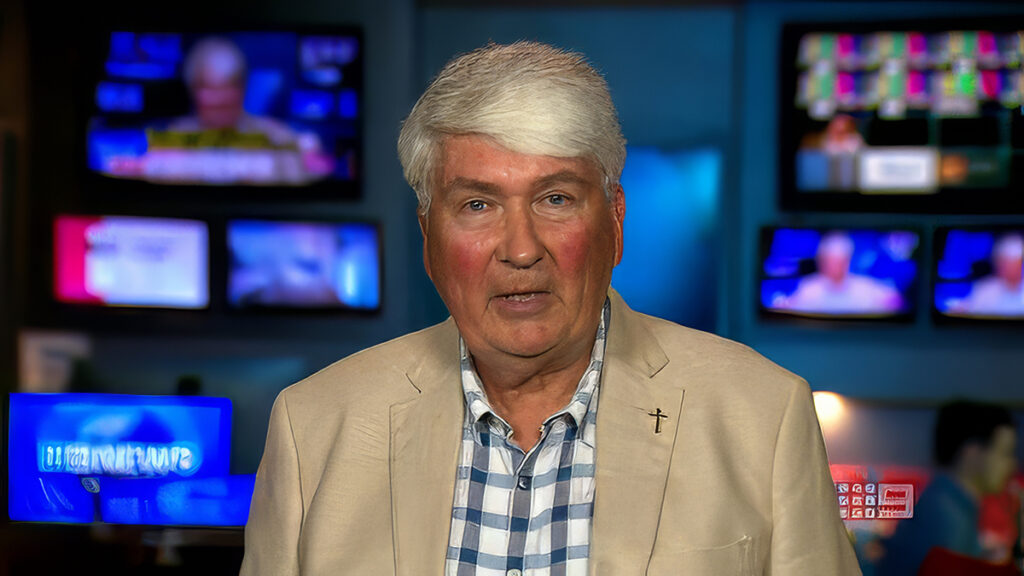
- Frank Brennan is a Jesuit priest, a professor of law and a leading commentator on Church and social and political issues.
- First published in the Weekend Australian. Republished with permission.