
Luke’s Emmaus narrative (Lk 24:13-34) is one of the richest well-rounded stories in the gospels — the disciples journey out from Jerusalem, meet a stranger on the road, come to a moment of recognition at table, and return to Jerusalem to retell it all.
If you heard the story in Roman Catholic church, the presider may have emphasised the last sentence: ‘… he had been made known … in the breaking of the bread’; and then commented that this is what is happening among us celebrating the Eucharist!
So it’s all fine and dandy then.
Reality check
But is there another side to this linkage, which impoverishes our language and reduces our worship to fakery?
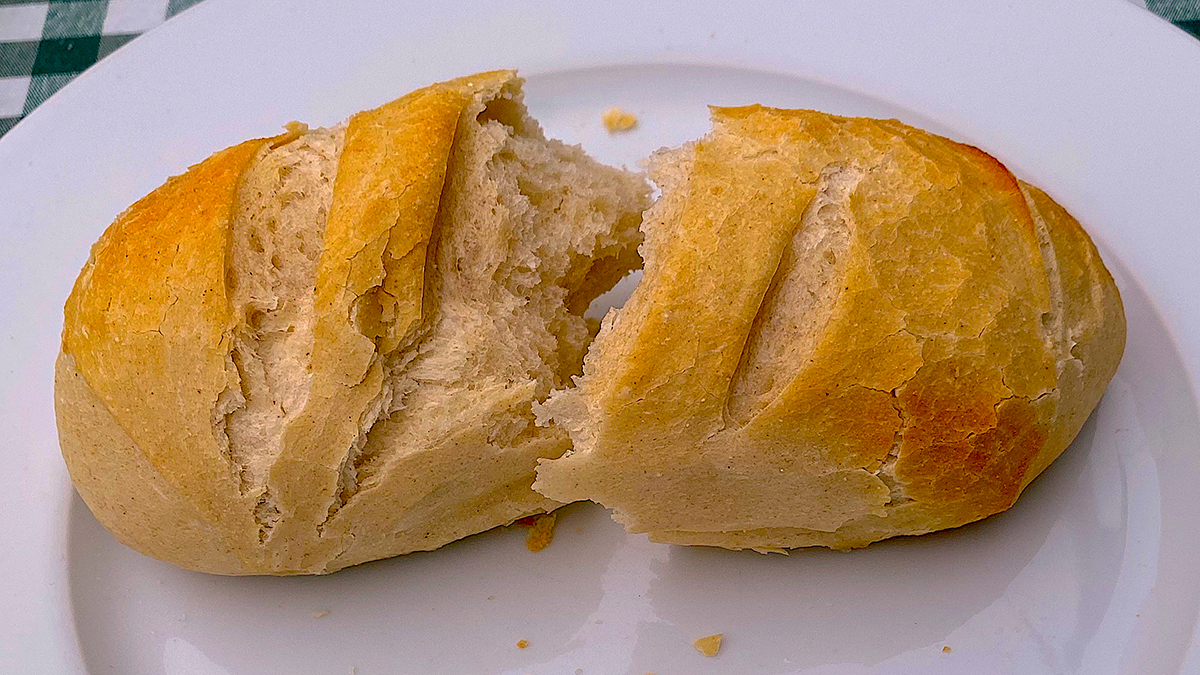
The key reality – for Luke and all who bless the Father united with the risen Lord – is that they recognised him in the breaking of a loaf of bread.
Let’s have a reality check.
First, what we use is not bread, it’s a wafer – we just call it ‘bread’ (i.e. ‘altar bread’).
Bread is produced by baking, a wafer by a boiling process.
Instinctively, we know it is not bread – you would never serve it alongside soup at a feast!
Second, it has often not been the focus of that celebration’s act of blessing God because we continue to use the tabernacle out of convenience. So what we actually eat is not directly linked to our celebration. So the link between presenting, blessing God, and eating – at the heart of the Emmaus story – is destroyed.
Third, what we use (20mm roundels, about 1mm thick) is not only not broken, it is not intended to be broken. We deliberately ignore the action of breaking. Yet breaking is the key distinguishing action of Jesus: we each get a share through breaking.
The pre-cut roundels are actually pandering to a consumerist style: individual products for individuals.
Fast food or feast?
The whole process has the implicit logic of the fast-food outlet, rather than that of the great banquet which is the imagery we explicitly invoke.
Our words and actions are always inadequate before the divine mystery – God is always greater – but they are all we have. Therefore, we have to use them with care.
We live in a world of falsehoods and fakery – where words are deliberately abused to confuse, deceive, and pretend that what is not the case.
Our liturgy must have a higher standard.
Indeed, it should set a standard that calls into question the quality of language we get from our so-called ‘great men.’
When we debase our words, our symbols, our actions – when we make them false – we confuse ourselves and impoverish our imaginations.
And yet from that shared table we’ve created divisions- the Eastern Orthodox Churches are shocked that we use an unleavened wafer rather than real bread.
We even tell ourselves false stories to justify it — such as that “we have always used unleavened bread.” No, that is not true.
Words, bread, and honesty
We must not make convenience and custom our guides to behaviour in the presence of God.
Take a real loaf, bless the Father, break it, and share it.
- Thomas O’Loughlin is a presbyter of the Catholic Diocese of Arundel and Brighton and professor emeritus of historical theology at the University of Nottingham (UK). His latest book is Discipleship and Society in the Early Churches.
- His latest book is “Shaping the Assembly: How Our Buildings form us in Worship”.