
Two persistent pressures shape restorationism: fear of a failed Christianity and the urge to purify it and the world.
Restorationism thrives at this point of tension. It promises clarity and growth where ambiguity and decline dominate. It offers revival strategies, re-evangelisation programmes, leadership pipelines, and liturgical reforms.
It forms small groups of devotees who believe this new credo. These groups then use “invitation” as the formula to bring in more members.
The in-group mentality
A common symptom is the creation of an “in-group” of the committed. Christians who choose not to participate are labelled apathetic or “baptismally lazy.”
As programmes fail and resistance grows, failure is projected onto the very soil rather than onto the programme itself or its underlying assumptions.
The Gospel parables of the Sower and of the Wheat and Weeds expose the depth of error in this reflex.
The parable of the sower
The Parable of the Sower disrupts any illusion of uniform reception (Mt 13:1–23; Mk 4:1–20; Lk 8:4–15). The Word is cast widely—almost recklessly—without careful pre-selection of the ground.
Restorationist programmes invert this Gospel logic. They read fragility as defect and non-participation as failure of discipleship. They overlook the ordinary drama of faith as it unfolds within diverse social, cultural, and spiritual lives.
The parable of the wheat and weeds
The Parable of the Wheat and Weeds sharpens this critique (Mt 13:24–30). The actual danger is not poor soil, but the impulse towards premature judgment.
The servants’ zeal to purify the field is explicitly rebuffed: to uproot the weeds now would imperil the wheat. Discernment belongs to the time of harvest—not to anxious, often clericalised, managers of growth.
Dismantling false ecclesiology
These narratives dismantle restorationism’s false ecclesiology, which conflates vigilance with control and purity with immediacy. Good and evil, fidelity and distortion, inevitably coexist in the Christian community—a truth revealed in the Paschal Mystery.
Liturgical restorationism as antiquarianism
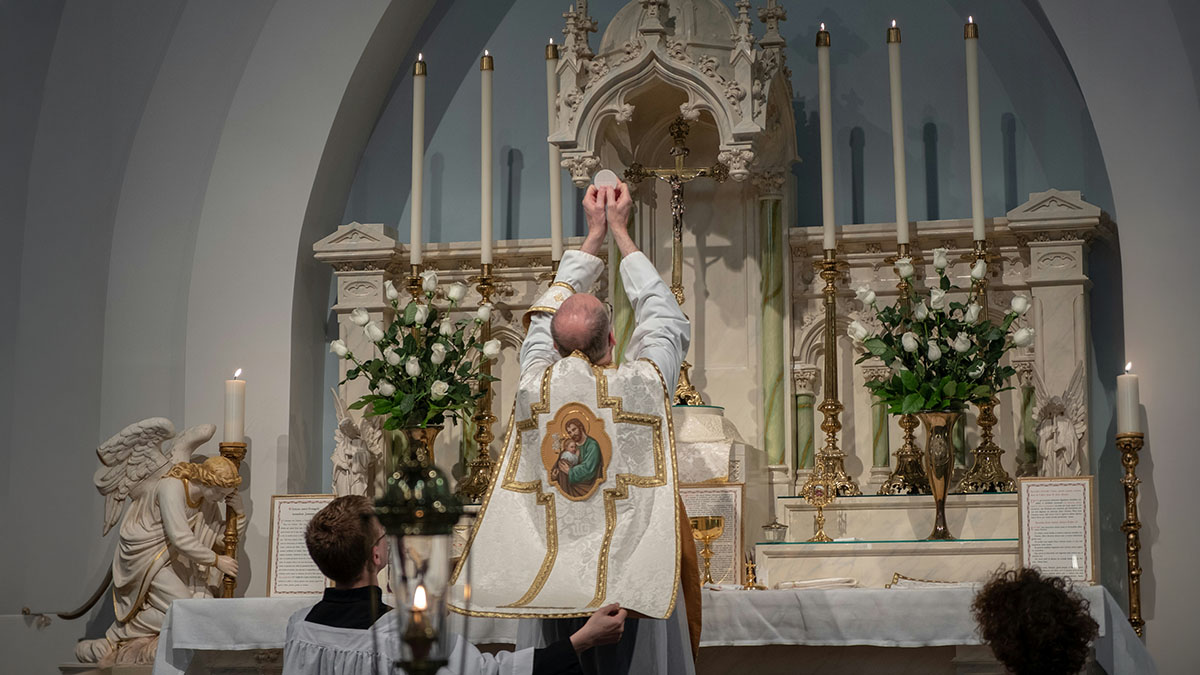
This false ecclesiology is evident in liturgical restorationism. The ongoing attachment to the 1962 Missale Romanum and the revival of pre-conciliar practices, such as ad orientem celebration, reveal the antiquarianism Pius XII warned against in Mediator Dei (1947).
Pope Francis echoed this warning, cautioning against turning liturgy into a “banner of division” or a haven from the more demanding labour of ecclesial conversion.
Antiquarianism lays bare the real reason for liturgical restorationism: it often sees liturgy as an aesthetic, historicist experience.
Celebrating ad orientem in cathedrals where the pre-conciliar altar faces west is less about cosmic eastward prayer. It’s more about reinforcing clerical distance and re-sacralising the priest as a figure set apart.
The divisive promise
Liturgical restorationism thrives at the point of tension. It promises clarity and growth to a small group of devotees. It offers them a new credo that justifies ritual changes that separate the wheat from the weeds.

- Dr Joe Grayland is an assistant lecturer in the Department of Liturgy at the University of Wuerzburg (Germany). He his a priest of the Catholic Diocese of Palmerston North, New Zealand.
- Ad orientem refers to a style of celebrating Mass where the priest faces the same direction as the congregation—typically toward the liturgical east (where the altar is located), rather than facing the people across the altar.