
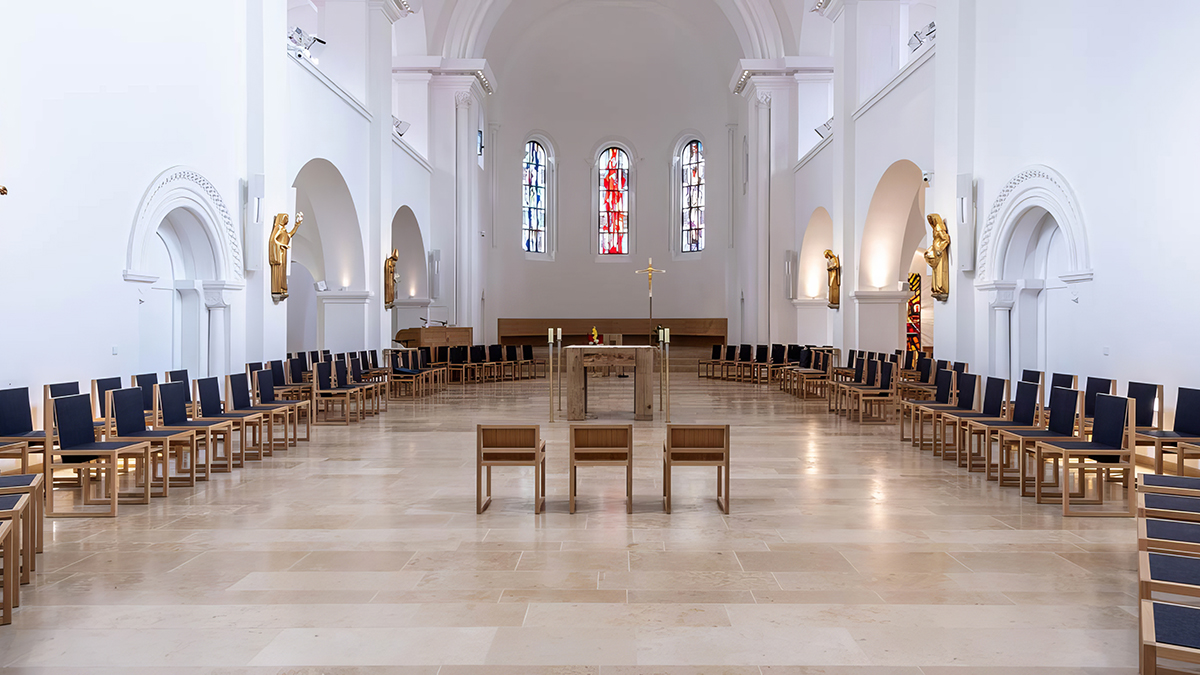
In October 2025, responding to the European Synod Team Leader’s request for more women in leadership and the ordination of women as deacons, Pope Leo indicated that “culture” was a determining factor.
He did not specify which “culture” barred the acceptance of women as professional managers or ordained ministers.
Some countries demonstrate greater or lesser acceptance of women as leaders and/or ministers, but the biggest barrier against women in the Church crosses all territorial boundaries. It is the culture of clericalism.
To be sure, not all clerics are infested with the clericalism that sets them apart from and above the people of God, male or female. Admittedly, laity too often enable the culture of clericalism.
Still, clericalism is a genuine hindrance to the processes and the aim of synodality: spreading the Gospel.
The report of the Synod on Synodality’s Study Group 4 provides a small window into how the clerical caste increasingly recognizes the dangers and the causes of clericalism.
The result of work by nine priests (including two cardinals) and one lay woman, the report is remarkably frank in its understanding of the pitfalls of current seminary formation and of how separating seminarians from the larger Church during formation is detrimental to them and to the whole Church.
The hope presented in the report is to create seminary formation programs that “avoid the condition of separation where irresponsibility, dissimulation and clerical infantilism are more easily bred.” (I, 6)
The inclusion of the terms “irresponsibility, dissimulation and clerical infantilism” in the document signals a recognition of a form of clericalism that extends beyond a single country or culture, damaging both individual clerics and the people of God.
Clerical narcissism rises
In fact, the report seems to recognize implicitly that it is no longer simple “clericalism,” but rather an insidious narcissism that can and in fact is infecting greater numbers of clerics, young and old.
As the number of ordained priests continues to decline, many of those remaining may find a sense of uniqueness in themselves and in their positions that moves them away from genuine service.
The symptoms of clerical narcissism are many:
- The Mass is not communal worship, but a performance by the priest that includes renditions of personal stories as “homilies.”
- The priest intensely cultivates his personal image as a charismatic leader, requiring both admiration and control.
- The priest-pastor attacks any person or public issues that endanger the unquestioning loyalty of parishioners, assistant priests, or staff.
- The priest is excessively defensive and overreacts to any criticism or correction.
Such clerical narcissism reduces to the spiritual abuses and failures of leadership where clerics — and here one can assume deacons are also eligible — believe themselves superior to the people they are appointed to serve.
In its worst forms, the cleric is angry, condescending, manipulative, and without empathy. The altar is his stage, and the Gospel a mere backdrop for talk-show-level preaching.
Did the Synod respond?
Synod members had asked for a review of the Ratio Fundamentalis Institutionis Sacerdotalis, the publication about priestly formation by the Dicastery for the Clergy, last updated in 2016.
The Synod also requested further theological study on the diaconate as a permanent vocation. In addition, it requested “theological and pastoral research on the access of women to the diaconate,” which question was assigned to Study Group 5.
As it happened, neither topic touching on the diaconate was fully explored by any Study Group.
Study Group 4 focused on the initial formation of priests, and in its final report it states that following initial consultation,
“it seemed appropriate not to touch the Ratio as such, but rather to draw up a preliminary document that would clearly outline the relational identity of ordained ministers in a synodal missionary Church and indicate principles and criteria for the implementation of the Ratio Fundamentalis and the Ratio Nationalis in harmony with this ecclesiological and missiological framework.” (Premise)
The stated objective and focus of Study Group 4’s report is noteworthy, as it presents the hope for “a broad and real participation of all members of the People of God in the formation of future pastors, with particular attention to the contribution of women and families; to foster the acquisition of skills indispensable for a synodal Church, such as listening, dialogue, co-responsibility and ecclesial discernment; and to educate for a more open correspondence to the missionary mandate of Jesus.” (Introduction)
Even so, the report implicitly avoids the fact of married men as candidates for holy orders, predominantly as deacons. Hence, the formation of and the potential for clericalism in deacons remains unaddressed.
Conversion as framework
The complete title of Study Group 4’s report is telling: “The Revision of the Ratio Fundamentalis Institutionis Sacerdotalis from a Synodal Missionary Perspective.”
Its main section focuses on the call to ecclesiological and pastoral conversion. It details and defines the need for conversion of relationships, to mission, to communion, to service, to a synodal style, and a conversion of formation.
Celibacy is mentioned just once, in the last part of this section of the document, which comments on a conversion of formation, although it also indicates the potential of married clerics.
The document recognizes both the positive and negative aspects of seminary training that sequesters candidates. The need for formation “for the Latin Church, the charism of celibacy with an intense spiritual life marked by guarded and guided rhythm.” (I, 6)
The report’s Guidelines present concrete objectives and suggestions, particularly that priestly formation be shared with all the baptized.
The Guidelines specifically recommend that candidates for priesthood be formed in what it terms “a participatory and synodal style.” (II, 2)
The report emphasizes the need for a synodal formation for mission. In all, the document uses the term “synodal” 99 times and “synod” 27 times, demonstrating its roots in the Synod on Synodality.
The short (17-page) report is bolstered by an Appendix that presents short paragraphs with examples of Best Practices from around the world.
For example, a diocese in Russia places the candidate in a parish for his propaedeutic year, while a diocese in the United States addresses the need for interiority.
Other examples, from the Americas, Europe, Asia, Australia, and Africa, present creative adaptations of traditional formation practices to the challenges of contemporary society. Throughout, there remains the emphasis on formation for mission in a synodal Church.
Finally, the document presents a roadmap for a process of implementation and monitoring, which directs each episcopal conference to establish a working group “to accompany the synodal review of priestly formation.” (Corollary, 1)
It presents a three-year timeline. It appears that the results of the proposed synodal analysis of priestly formation are expected to be brought to the October 2028 post-synodal Ecclesial Assembly in Rome.
Formation alone falls short
Problems in priestly formation were well discussed and considered throughout the various phases of the 2021-2024 Synod on Synodality.
Entries from around the world routinely questioned the ways in which men were accepted as candidates and eventually ordained as priests.
It would appear, however, that no matter how noteworthy the review of formation processes may be, there is no evaluation of the central problem extant among too great many men already ordained.
Clericalism exists. It has been acknowledged as a leading cause of any decline in church attendance.
It can be especially acknowledged as a reason for women to leave the Church, bringing their husbands and children with them.
Once bolstered by a particular form of clerical narcissism, it becomes self-replicating.
No matter how well-formed a newly ordained priest may be, he may risk being placed with a self-proclaimed “charismatic leader,” who can pose a stark choice: my way or the highway.
The unfortunate result can be a new cadre of clerical narcissists only too willing to ignore synodality.
- Phyllis Zagano, Ph.D. is senior research associate-in-residence and adjunct professor of religion at Hofstra University, Hempstead, New York.