
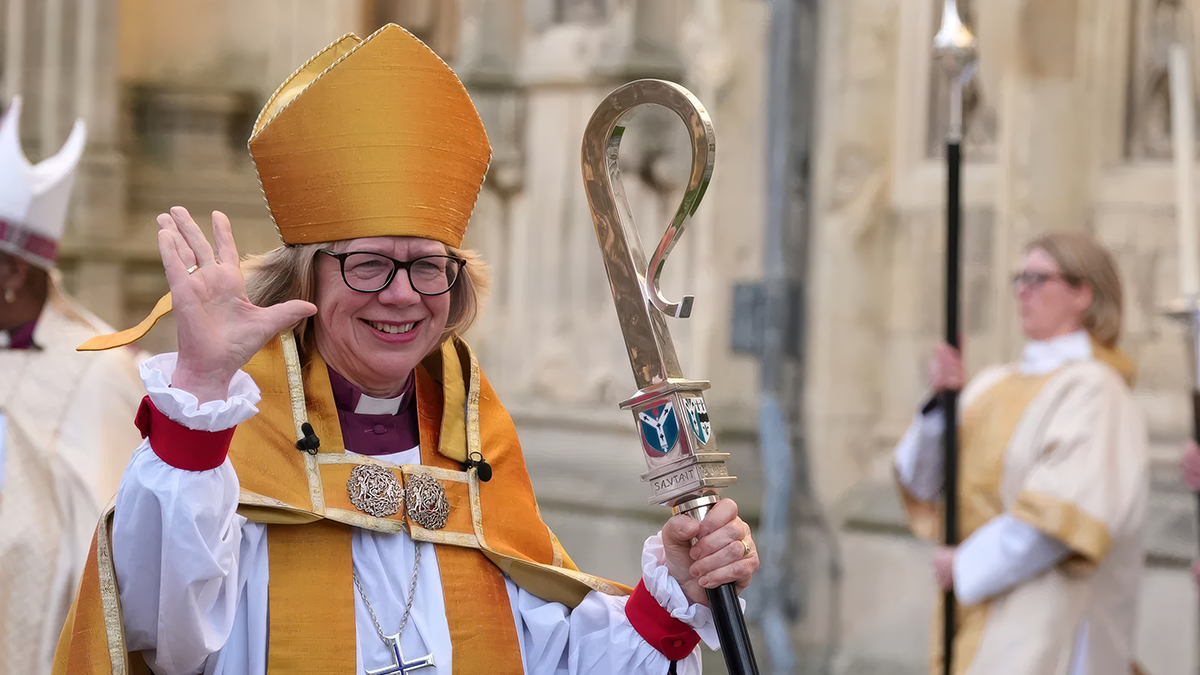

As Sarah Mullally struck the door of Canterbury Cathedral to gain admission for her installation as Archbishop of Canterbury, a very chunky emerald ring was caught on camera. A quick check of the online order of service confirmed that it was indeed the ring that Paul VI gave to Archbishop Michael Ramsey in 1966.
It’s such an important artefact in the history of ecumenism, and even if it’s too valuable (and chunky) for everyday wear, I hope she will wear it when she visits Rome, 25 – 28 April, 2026, during which time she will meet with Pope Leo XIV.

The morse (clasp) fastening her cope had an equally intriguing history. This newly created ecclesiastical object had been fashioned from the belt buckle of Mullally’s nurse’s uniform. It must have spent many years in hospitals and at patients’ bedsides.
It is not surprising that this Archbishop talks a lot about foot washing. She has washed many bodies.
A joyful installation
There was a joyfulness and lightness in the installation, reflected in the sustained, spontaneous applause that broke out at the end of the service. The day chosen was the Feast of Annunciation — perfect for an installation during Lent and for foregrounding women’s experiences.
There were plenty of senior female clergy in evidence — from the provinces of the global South, the Church of England and other parts of the Anglican Communion, and the Lutheran and Free Churches. In the congregation of two thousand, there were many women and men of other faiths and professions.
Women’s voices foregrounded
Female musicians were much in evidence, and the medieval mystic Mother Julian of Norwich made an appearance, with a new setting of her words “All Shall Be Well.”
Other themes were layered on. Pilgrimage was a prominent one, Archbishop Mullally having walked the eighty-seven miles from St Paul’s Cathedral to Canterbury.
Nothing is impossible
The possibility of nothing being impossible with God (Luke 1.37) was the theme of her sermon. A few years ago, it would have all seemed impossible.
It would be naive to assume that Archbishop Mullally — or any other leader, whether female or male — will be able to heal the rifts in the Church of England, still less those in the Anglican Communion. But a new spirit of healing seems powerfully present at the start of her ministry.

- Frances Knight is Professor Emeritus in the History of Christianity at the University of Nottingham, where she previously served as Head of Theology and Religious Studies and Director of the MA in Church History. A former President of the Ecclesiastical History Society, she is now a freelance historian, academic consultant, and Co-Director of Samaritans of Aberystwyth and Mid Wales.