
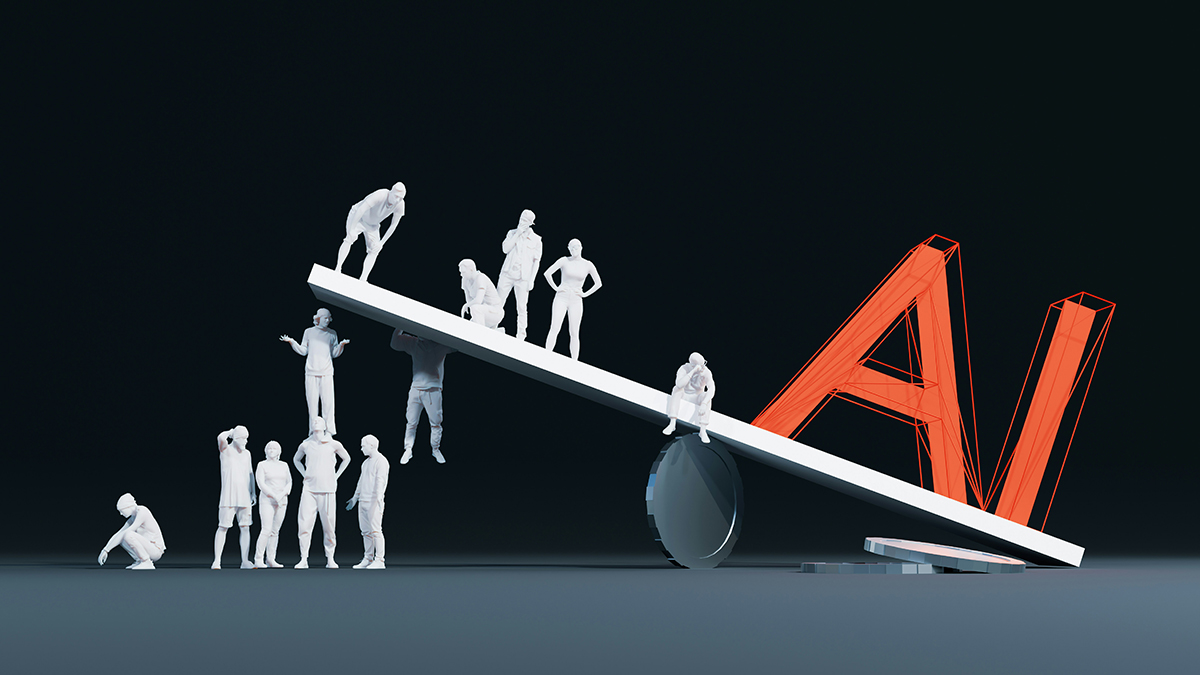
Artificial intelligence demands an ethical and moral response from religious believers. Yet, before we can offer that response, we have to be clearer about what artificial intelligence is and the threats that AI poses.
Often, I think the rush to respond to AI has been like the rush to embrace it or invest in it — premature. AI has generated an extraordinary windfall for investors even as its use and its danger are not yet well understood.
Indeed, a whiff of artificiality hangs on how AI has been foisted on us all so rapidly. I can think of no other technical innovation that has demanded so much cheerleading for its adoption. Anything so transformatively useful should speak for itself.
A sort of magical thinking seems to surround AI, and it’s hard not to feel sometimes like it is being oversold for somebody else’s profit.
Intelligence it is not
Some of that overselling is in the name. AI is misnamed as an “intelligence.” We all know how pervasive “AI hallucinations” and “AI slop” have become.
This is because AI lacks the synthetic, creative, and original quality that intelligence has. AI is a large database of information with an algorithm that identifies patterns to sort for outputs.
But the oldest problem of any computerized process remains — garbage in, garbage out. The machine cannot sort information in the same way we can. The machine lacks intelligence. It has no judgment. Our minds are something else.
AI will improve. But on any foreseeable horizon, AI will be more accurately described as a tool for people with intelligence to use, not as intelligence. That does not mean that AI is harmless.
Efficiency over persons
The greatest harms arising from AI will seem to be those ways it creates efficiencies that exploit persons for profit or how AI disrupts our relationship with information itself, giving us false data, false images, and false videos.
All of that is bad. But something deeper is happening too. It is more corrosive and worse than all that.
More than improving anyone’s life, what drives AI is the hope for profit. For all the additional inequality that desire has created without any care for ecological or social consequences, the deeper problem is that the motive for profit values efficiency more than anything else.
The purpose of AI is to render human persons and creative human labor extraneous.
Persons are irreducible goods
Catholic social teaching reminds us that persons are irreducible goods. The Church calls us to see persons as integrally related to all of Creation. Persons never can be so peripheral as those purveying AI conspire to make them seem.
An anthropological challenge
Pope Leo has said that AI encroaches on “human relationships.” The challenge posed by AI, he said, “therefore, is not technological, but anthropological.” AI challenges who we are, what we are, and what we do.
Leo seems very concerned about artificial intelligence. He has spoken about it several times in just a year, and I feel sure we will hear more from him soon.
The challenges AI poses are only beginning to come into focus. We all need to be watching, listening, and learning in days ahead.

- Steve Millies is the director of The Bernardin Center at CTU. A political theorist who trained at The Catholic University of America, he taught political science for 15 years at the University of South Carolina Aiken before coming to Catholic Theological Union (Chicago, IL) where he teaches courses in history and Catholic social ethics.