
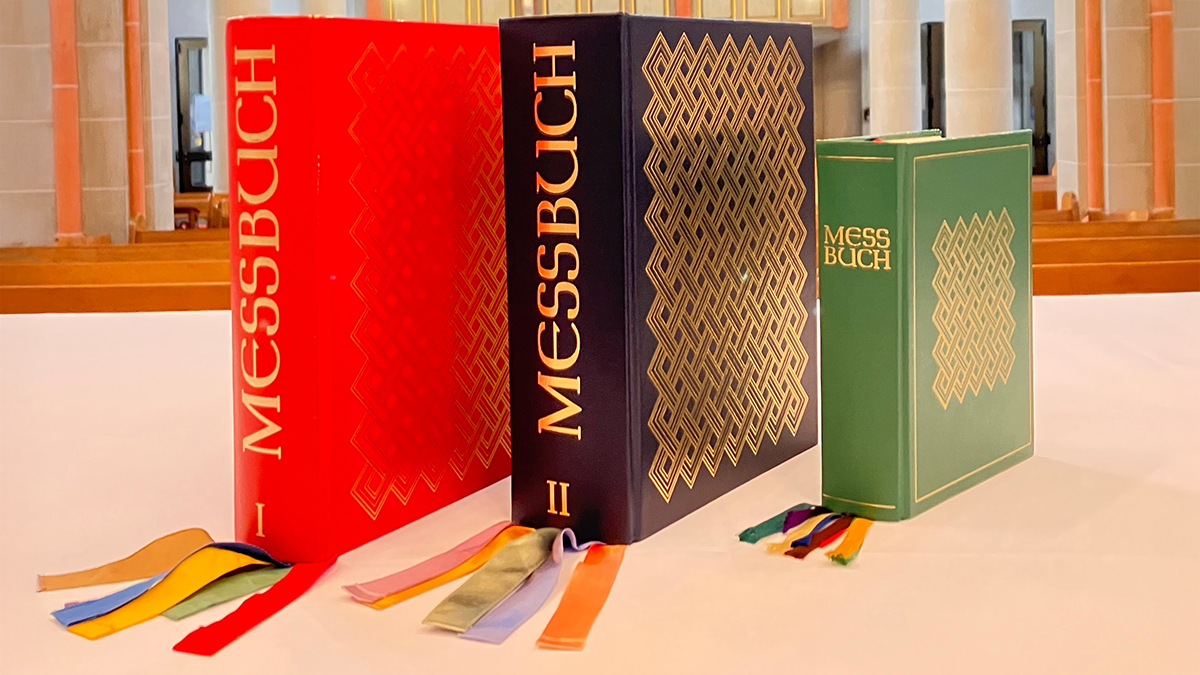
The Mass book or Missal expresses a local Church that takes its language and cultural identity while remaining fully embedded in the communio of the universal Church. It demonstrates that liturgical tradition remains alive when shaped by the dialogue between normative guidance and lived faith.
The Roman Missal constitutes the central normative source for the celebration of the Eucharist and, as the editio typica, shapes liturgical practice throughout the universal Church. In the German-speaking region, this includes Germany, Austria, Switzerland, but also Luxembourg, parts of Belgium, Alsace (France), South Tyrol (Italy), and Liechtenstein.
Like other language groups, this there are important differences in language cultures and local dialects.
From Latin to the language of the assembly
Before the Second Vatican Council, the Missal existed solely as a Latin book. The participation of the faithful relied on supplementary people’s missals—most notably in Germany, the widely used Schott—which provided only indirect access to the liturgy.
Sacrosanctum Concilium as a turning point
The Constitution on the Sacred Liturgy introduced a fundamental shift in perspective. Full, conscious and active participation—actuosa participatio—became the principal criterion of liturgical renewal. The vernacular emerged as a decisive means for experiencing the liturgy as a communicative and community-forming action.
The German-speaking reform process
In the German-speaking Church, the implementation of the reform was shaped by the heritage of the Liturgical Movement, an extensive body of liturgical scholarship, deep biblical engagement, a pronounced linguistic sensitivity, and rich musical traditions. Thus, the translation work acquired a distinct theological and cultural profile.
Synodal procedures
Beginning in 1964, newly translated texts were tested in parish settings. A broad ecclesial learning process unfolded in which translators, liturgical institutes, the bishops’ conferences of the region, and Roman authorities collaborated closely. Reflection on pastoral practice became a decisive criterion of liturgical norm-making.
Language as a theological category
It soon became clear that liturgical language must combine intelligibility, biblical grounding, doctrinal precision, poetic quality, and musical suitability. The characteristic linguistic style of the German Missal („Messbuch“) did not arise by accident but from a theological understanding of language as a form of communicating faith.
Text and music as a liturgical unity
The reform further revealed that liturgical texts must always be considered in relation to their musical realization. New chants, acclamations, and forms of congregational singing emerged alongside the translation work and contributed to the final formulation of the texts.
Promulgation and reception
With approval and publication in 1975, followed by mandatory implementation in 1976, the German-language Missal became firmly established in parish life. The use of the vernacular thus became a natural dimension of liturgical participation.
The process of writing and using a liturgical book like the Missal is never static., neither is its revision. The revision of the Missal is part of the living development of worship, so that the celebration of the Eucharist may remain theologically coherent, aesthetically compelling, and communally experienced.
Theological and pastoral challenges
Today’s revision touches on key issues of liturgical theology, including the relationship between universal norms and local ecclesial identity, the question of appropriate religious language in increasingly secular contexts, and the close interplay of textual formulation and musical tradition.
The issues of gender-inclusive language also play an increasing role, in order to express the diversity of the faithful in an inclusive manner.
Incomplete revisions
Two revision efforts have already taken place, first from 1988 to 2000 and again from 2004 to 2013. Both failed due to differing views on how fidelity to the Latin original and the communicative and musical quality of the vernacular should be balanced.
Reorientation through Magnum Principium
The instruction Liturgiam authenticam (2001) required particularly literal translation of Latin texts. This was met with significant criticism in German-speaking dioceses, where concerns arose regarding intelligibility, prosody, and liturgical sing-a-bility. Unlike the English-Speaking churches that accepted their translations.
Only with Magnum principium (2017), issued under Pope Francis, was the responsibility of bishops’ conferences for translation and inculturation strengthened once again. This motu proprio places pastoral practice more clearly at the center: liturgy must work in proclamation, in hearing, and in singing.
The current path toward a new edition
The present revision process in the German-speaking region follows a three-stage approach:
- the translation of all missing parts of the editio typica tertia of the Missale Romanum (2002/2008), together with the creation—for the first time in this linguistic area—of pericope-based orations modeled on other vernacular editions;
- the linguistic revision of existing texts in a process of pastoral testing;
- the integration of all newly developed material with the distinctive texts and rites proper to the German-speaking Church, with the possibility of supplementing additional proper texts where needed.
Feedback from parish communities and scholarly expertise plays a crucial role throughout this process.
Perspective
Completion of the new edition is expected no earlier than 2028. Approval, Roman confirmation, editorial preparation, and printing will require additional years.
The path toward a new Missal itself testifies to the nature of liturgical reform: the liturgy is never finished but continually unfolds in the dynamic tension between tradition and the present.

- Dr Manuel Uder is editor of the journal Gottesdienst and a staff member of the German Liturgical Institute.