
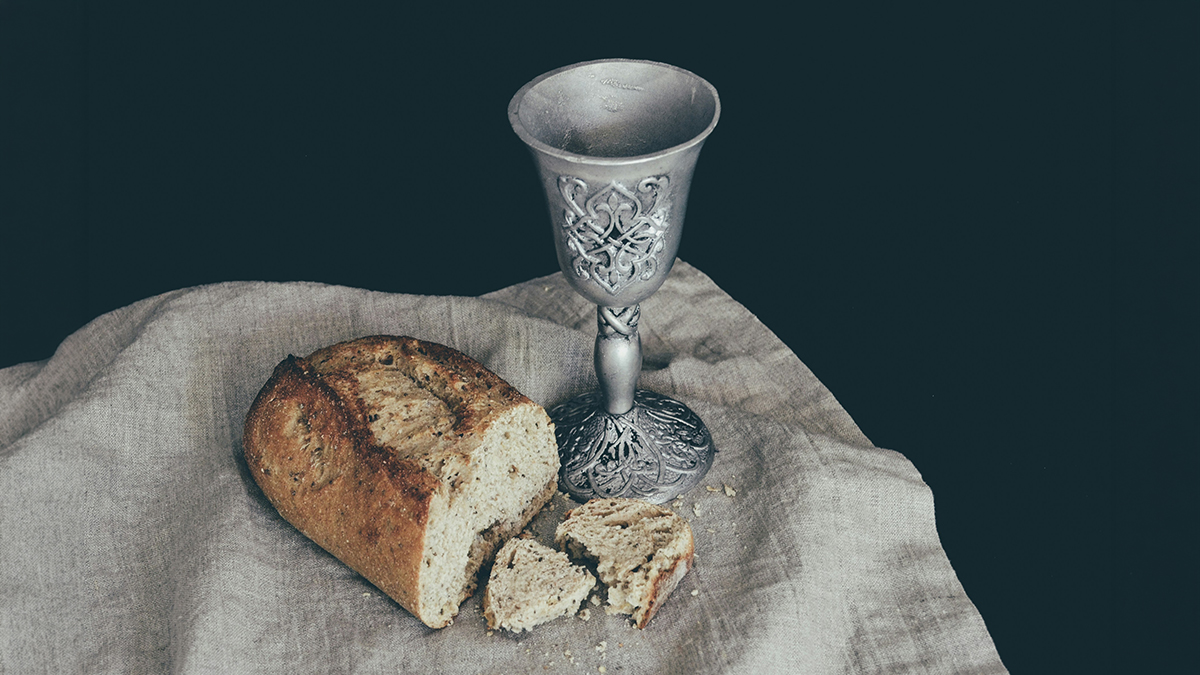

Holy Thursday draws the faithful into Jesus’ eagerly awaited celebration of the Passover meal with his friends, shared to sustain him in his Passion.
The scriptures issue a threefold challenge:
- To remember Jesus’ celebration of the Passover and humanity’s salvation through His blood.
- To receive the Eucharist in memory of Jesus, who gives his body and blood to sustain us in our suffering.
- To wash the feet of others, following Jesus’ example of humble service.
The Eucharist as a source of division
Tragically, the Eucharist has become a sign of division. Some long for a time when the Mass was the same everywhere.
It was familiar, if unintelligible, with the celebrant facing the altar and separated physically from the congregation. For many, it was time for private devotion.
The divisions remind us of the ancient truth, lex orandi, lex credendi, how we pray demonstrates what we believe about God, community and liturgy. Liturgy ritually prepares us for life.
Continuing Vatican II renewal
In the early church, the Eucharist celebrated in home churches were meals of friends around a table. By the time of Constantine and the Holy Roman Empire, large churches looked like royal court halls or concert theaters with passive observers.
Debates about liturgy are not new. St Pius V (1566-1572) was charged with implementing the reforms of the Council of Trent and to heal a Church shattered and scattered by the Reformation. He declared “there ought to be only one rite for celebrating the Mass.”
Vatican II declared the Eucharist “the source and summit” in Lumen Gentium and called for “the full, conscious and active participation of the faithful.” There has been ongoing resistance to the reforms of Vatican II.
The Latin Mass and polarization
In the late 2nd century, Eucharistic prayers were translated from the elite of Greeks to the Latin of the common people. Pope Francis’ apostolic letter, Traditionis Custodes, curbed the Latin Mass in the “search for ecclesial communion.”
Pope Leo XIV has defended Pope Francis’ restriction and affirmed the Vatican II liturgy as “the sole expression of the lex orandi in the Latin rite.” He has formed a new study group on liturgy and warns that “divisions over Latin Mass risk turning into ideologies and polarization must never be a political tool.”
Learning from meals with friends
At joyful meals with friends, such as birthdays and anniversaries, friends hug, laugh, sing, cry and share stories and invite others in. Meals strengthen us to go out and share with others, including those who eat alone, in hospitals, in refugee camps and places of suffering.
There can and should be some cultural diversity in liturgy but it cannot compromise our essential communion or present competing fundamental truths about the Eucharist.
Being real friends takes work but Jesus says “I have called you friends.” (Jn 15:15) His meal provides our strength.

- Nuala Kenny is a Sister of Charity in Halifax, Nova Scotia, and a pediatrician. An officer of the Order of Canada since 1999, she has published several books, including Healing the Church (Novalis, 2012) and Rediscovering the Art of Dying (2017). She is co-author of Still Unhealed: Treating the Pathology in the Clergy Sexual Abuse Crisis (Novalis and Twenty-Third Publications, 2019). She most recently published A Post-Pandemic Church: Prophetic Possibilities (Novalis and Twenty-Third Publications, 2021).