


Christians gather on the Lord’s Day in the context of a time and place to break open the Word of God and celebrate the Eucharistic memorial.
They do what the Church has done from the beginning—reinterpret the gospel message so that it guides the worshipping assembly and offers hope and assurance.
The Sunday Eucharist is the principal act that sustains and nurtures the assembly of believers from week to week.
Spirit of seventy three
In the early days following the Vatican Council committees would meet regularly to prepare liturgies that spoke to their needs.
In parishes and schools, groups formed to reflect on the Sunday readings, choose hymns, write universal prayers, decorate the altar and ambo, appoint and prepare ministers.
Vernacular language Masses were celebrated for new migrants.
Masses were prepared by and for children, families and young people, the sick and elderly—mirroring the 1973 International Eucharistic Congress held in Melbourne.
Dioceses and parishes took seriously their responsibility to form priestly people skilled both in the performance of the liturgy and its execution.
Shadows of the rubric
In the decades that followed, however, self-appointed observers visited parish liturgies with the express purpose to seek out what they decided were inconsistencies with the “tradition”.
They voiced their complaints, not to local church leaders, but to sympathetic bishops, and were even encouraged to approach the Roman dicastery itself.
To these individuals, “rubrical correctness” became the yardstick of a “Catholic” liturgy, with no regard for the celebrating Body of Christ.
Their critique extended beyond parishes.
They regarded with suspicion and vocally opposed liturgical educators who had studied with integrity and rigour the principles of Sacrosanctum Concilium.
Fading echoes of formation
Sixty years after the Second Vatican Council worshipping communities are smaller, and Sunday Eucharist is not even regularly available in country areas.
Even though Francis, and more recently Leo, have stressed the importance of liturgical formation, and the centrality of the Eucharistic celebration, trained liturgists are rare and poorly renumerated, seminary curriculums include few courses on liturgy and sacraments, and dioceses and episcopal conferences have long since ceased to consider liturgy a priority.
Without such support, the quality of liturgical celebrations has degenerated.
The assembly of the Body of Christ, affirmed in the tradition by the Council Fathers as the primary minister of the Eucharist, is made to once again give way to the “cultic” priest.
Priesthood of the baptised
Rubrics take precedence over pastoral concerns, resulting in a “generic” Sunday Eucharist — even on special feasts.
At a time when world leaders are preoccupied by war, selfishness, greed and the abuse of power, it is imperative that Christians exercise their priestly role in the Sunday liturgy.
The Eucharist is God’s gift for all the baptised to share.
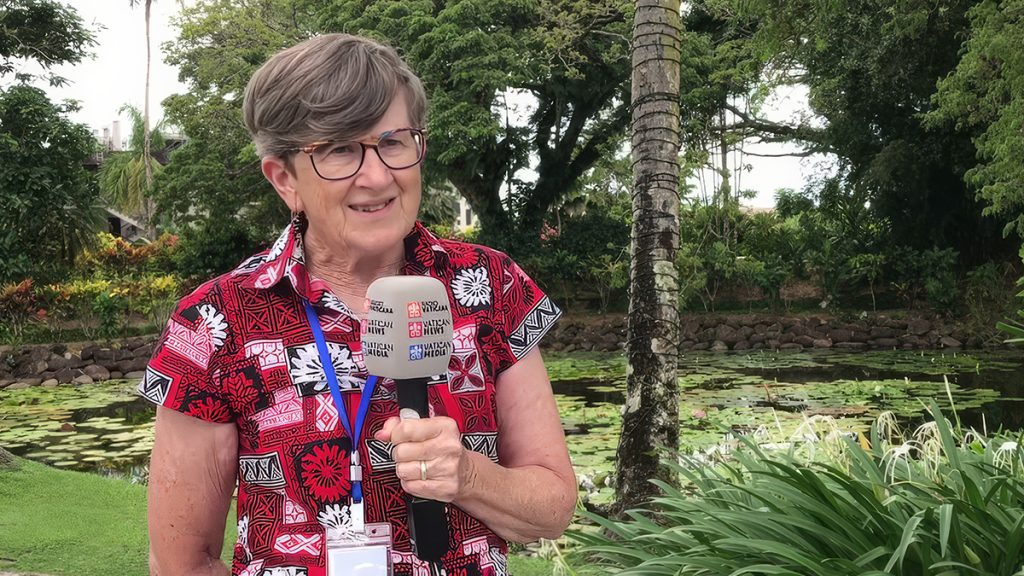
- Carmel Pilcher RSJ, PhD is a Liturgy and Culture Consultant and Educator, Darug and Gundungura country.