
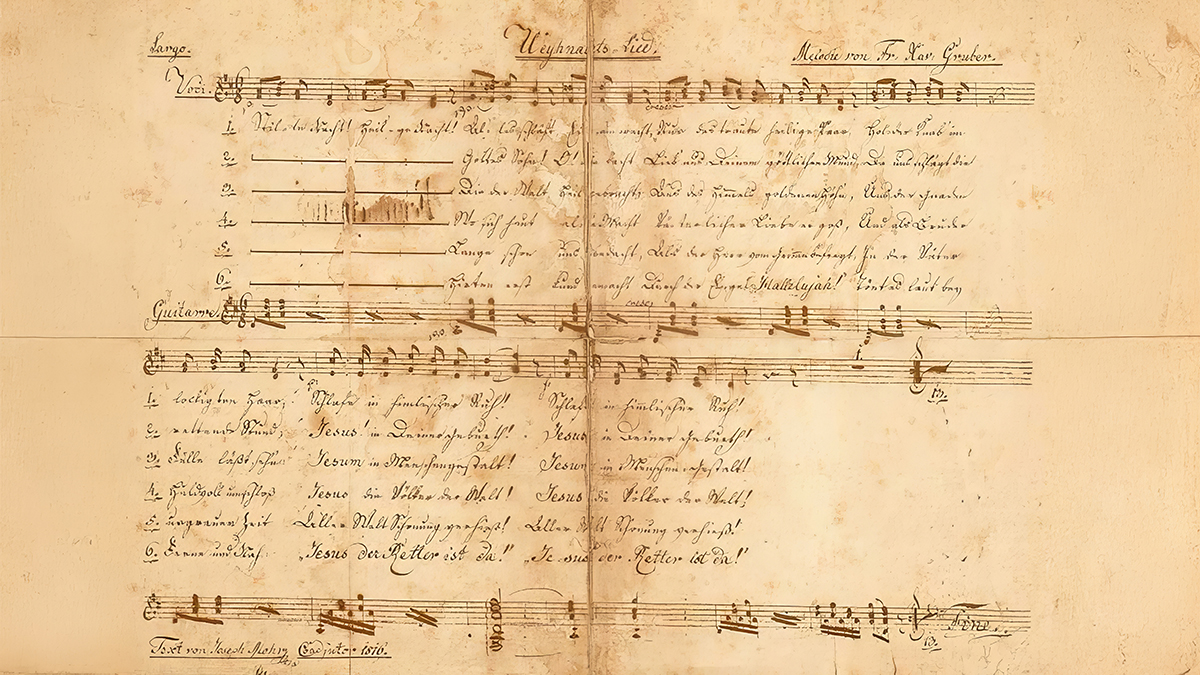

Joseph Mohr, who wrote the words of Silent Night, was the son of a single mother and grew up in a hangman’s cottage!
His father was a mercenary soldier and deserter called Franz Mohr, whom he never met, and his mother was Anna Schoiberin.
The hangman provided accommodation for single mothers and their children, seeking to improve his reputation through charitable works.
So it came about that Joseph Mohr was baptised in Salzburg Cathedral with the hangman as his godfather.
The local priests provided for Joseph’s education. He was ordained a priest at the age of twenty-three, and his first appointment was to the village of Mariapfarr, Austria, in 1816.
A world without summer
The year 1816 was known as “the year without a summer.”
The sun was masked by volcanic smoke from the 1815 eruption of Mount Tambora on what is now the Indonesian island of Sumbawa. Temperatures in continental Europe were on average 3 degrees Celsius below normal. There were violent storms. Rain and even snow, often polluted, fell incessantly.
Crops failed, and hunger was rife as cold summers and poor crops continued.
So, 1816 was ghastly for Austria and Europe as a whole.
Devastated and brutalised by the twelve years of the Napoleonic wars, people longed for peace.
In the church in Mariapfarr, there was a painting of the Nativity of Jesus, which Joseph would have seen every day. Possibly this painting inspired the words for his poem, which “encapsulated his love of God and his people’s longing for peace in troubled times.”
Mohr’s parishioners lived in poverty, hunger and distress. His six-verse poem gave voice to their longing for reassurance that God still cared.
The German text declares that today all the power of fatherly love is poured out, and Jesus, as brother, embraces the peoples of the world.
Birth of the carol
In 1817, Joseph transferred to Oberndorf, just south of Salzburg. The town became Austrian in 1815 at the Congress of Vienna, when European borders were redrawn after the Napoleonic Wars.
Franz Xaver Gruber was a teacher in Oberndorf, as well as being the sacristan, organist and choirmaster at the Church of St Nicholas, where he and Joseph Mohr became friends.
Joseph asked him to write a melody for the words of the poem he had written in 1816.
It was written in a single day, Christmas Eve in 1818, and performed for the first time after midnight Mass.
The damaged organ in the church was unusable, so Joseph played the guitar, “the people’s instrument,” as they sang together:
Silent night, holy night.
Brought the world peace tonight
From heaven’s golden height
Shows the grace of his holy might
Jesus, as man on this earth
Jesus, as man on this earth.
The carol is sung everywhere in the world today, translated into at least 300 languages, and remains immensely popular.
Between 1978 and 2014, the US Copyright Office registered 733 recordings by different singers.
It was declared “as a treasured item of Intangible Cultural Heritage” by UNESCO in 2011.
A prayer for peace
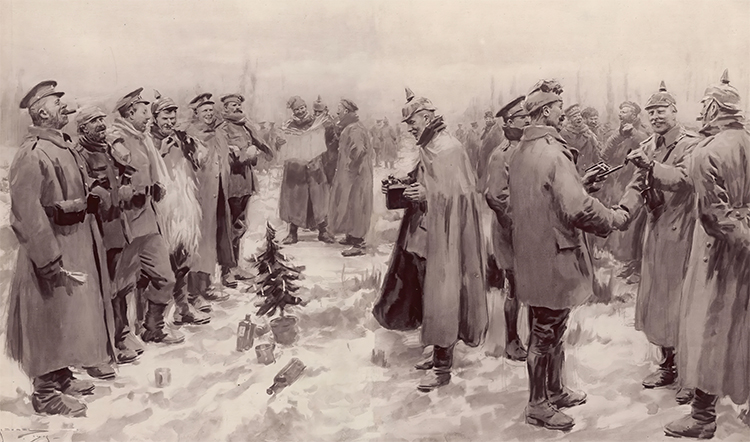
The power of this simple carol was illustrated on Christmas Eve in World War I. Private Albert Moren, of the 2nd Queens Regiment, reported that near the French village of La Chapelle-d’Armentières, he heard German soldiers singing Silent Night.
Rifleman Graham Williams, of the 5th London Rifle Brigade, described the atmosphere:
“Then suddenly lights began to appear along the German parapet, which were evidently make-shift Christmas trees, adorned with lighted candles, which burnt steadily in the still, frosty air. First, the Germans would sing one of their carols, and then we would sing one of ours. The Germans immediately joined in, and I thought, well, this is a most extraordinary thing – two nations both singing the same carol in the middle of a war.”
On Christmas Day, there were several reports of Germans and British holding joint services to bury their dead, and exchanging greetings and gifts in No Man’s Land.
By the mid-nineteenth century, even as the carol spread across the world, the names of its creators had slipped from public memory.
Franz Gruber, a successful musician, died at the age of 76 in 1863.
On the other hand, Joseph Mohr, who had become the parish priest of Wagram, died in 1848 and was so poor that there was no money for his burial.
No one knew he had written the lyrics of Silent Night, and his grave was forgotten.
Mohr’s burial place was rediscovered after World War II and was given the honour due to the writer.
Every Christmas Eve, a choir sings Silent Night at his grave, “simple words of faith in hard times, words that continue to find hope in the God who cares, centuries later.” The carol is a beautiful prayer for peace in our troubled, sad and wounded world, articulating our human longing for peace.
May the promise of Christmas peace be realised in our hearts, in our homes, and in our country, as we pray that the peace of Christ will reign in our world.

- Kevin Head SM is a former editor of the Marist Messenger, where this article first appeared.
- Among the sources used for this article are:
- The First Silent Night, TV documentary 2014, hosted by Simon Callow
- Wikipedia
- Sarah Eyerly, The Conversation, 19 December 2018
- Michael E Ruane, The Washington Post, 24 December 2018