

Women deacons are in effect working well in the Church, except we do not call them deacons, and they are not ordained.
This is the view of Dr Joe Grayland, theologian, author and former parish priest of three parishes in Palmerston North, New Zealand. Grayland questions whether we need another form of the clergy.
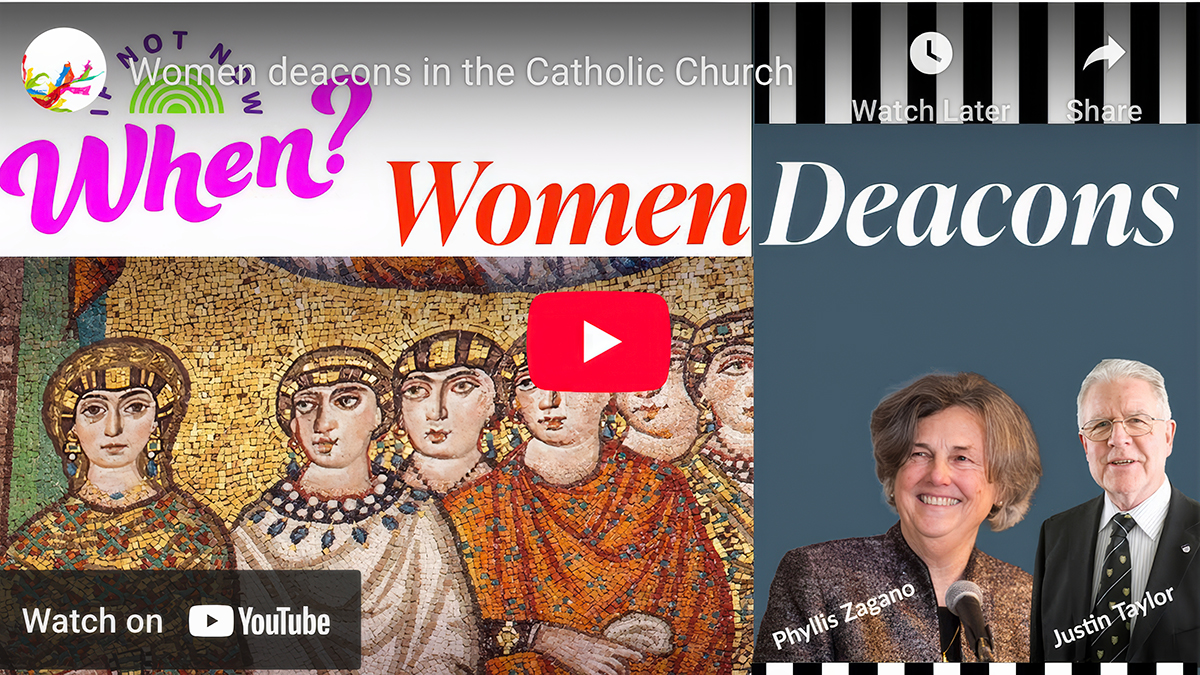
Grayland made the comments in 2021 during a discussion on Flashes of Insight, – Women Deacons in the Catholic Church, a conversation with Phyllis Zagano, Emeritus Professor of New Testament at the Ecole Biblique, Justin Taylor and hosted by Emeritus Professor of Historical Theology at the University of Nottingham Thomas O’Loughlin.
The need for an expanded diaconate
Grayland asks if the Church actually needs permanent male or female deacons. If it does, he suggests we need to change the understanding projected by the transitional diaconate modelled in seminaries.
Grayland says he works with eight women across the three parishes; they serve the community, they work full-time, but none are ordained. We might need more priests, but Grayland says the last thing we need is an expanded clerical class, the permanent diaconate.
Zagano advocates for women deacons
It is not a perspective Zagano shares. Zagano is an internationally recognised scholar, prolific writer and advocate for women deacons.
She says that if anyone wants to be a deacon to get power, they have other issues. The ministry of the deacon is one of service, she says.
Zagano says it is essential to have a specialised view of ministry and that the diaconate should not be limited to in-house Church functions. Zagano says the office of the deacon is distinct from the function of deacons.
Deacons hold the same office, but their ministry of service would be expressed differently, she said. She says that if people want to go to confession, they see a priest, and if they go for food, counselling or spiritual direction, deacons can offer the service.
If our prime concern is not to expand the clerical class, why ordain anyone, she asks. She, however, noted that if the Church were to reintroduce deacons, there is a question around whether they would be installed or ordained.
Historical evidence supports women deacons
Zagano says there is no doubt that women were deacons in the Early Church. It is a point that Taylor, who works on some of the earliest evidence the Church has, agrees with.
Taylor says that it is clear from both scripture and the documents from the first thousand years that women were deacons. When the Early Church spoke of deacons, there was no distinction made between male or female.
Taylor says that, whether deacons were men or women, the Early Church saw deacons as officeholders, not just functionaries.
Looking toward the future
Questioned by O’Loughlin about the future, Grayland says that women’s ministry should not be seen as a threat to male in ministry. He commented that, when looking at the evidence, if the Church is going to have women deacons, it needs to popularise it as part of the Church’s evolution.
He says that, reflecting on what Zagano and Taylor have discussed, the Church needs to understand that the development of women’s diaconate is not a straight-line trajectory but an evolution.
Grayland says he hopes our Church’s understanding of women’s ministry and women’s diaconate will change but wonders why we do not have women deacons now.
Spirit of discernment needed
Zagano agrees and says we must not go forth in political discussion but with a spirit of discernment. She says a wise bishop once wrote to her about discernment.
“Discernment is not an organisational technique, and it’s not a passing fashion, but it’s an interior attitude rooted in an act of faith.”
“Discernment is the method and at the same time the goal.”
“It’s based on the belief that God is at work in the history of the world in the events of life and the people we meet and who speak to us.”
“This is why we are called to listen to what the Spirit suggests to us in often unpredictable ways and directions.”
“As one might assume, he’s a Jesuit bishop,” she says.
Listening to the People of God
Zagano concludes by saying it is essential that theologians listen to the People of God and that the People of God make their needs known. In a spirit of discernment, Zagano is convinced that if the People of God make their needs known, they will not be denied.
As to the future, Zagano says we need a genuine, prayerful discussion to move toward a future in which the Church restores the tradition of women in ministry and the diaconate.